
You’ve probably seen the claim. Maybe on a training forum, maybe in a podcast, maybe from a well-meaning teammate: ice baths kill your gains. Stop using them after hard sessions. You’re sabotaging your own adaptation.
If you’re a cyclist who has avoided ice bath cycling recovery because of that warning, you’ve been solving someone else’s problem. The research behind the “cold kills gains” narrative tested resistance training — specifically, whether cold water immersion (CWI) blunts muscle growth in people lifting weights. For cyclists, the evidence tells a different story. And the gap between what cyclists think they know about ice baths and what the research actually shows for endurance athletes is one of the most consequential misunderstandings in amateur cycling culture.
The endurance exemption
That fear has a legitimate origin. A 2024 meta-analysis in the European Journal of Sport Science confirmed that regular CWI after resistance training does attenuate hypertrophy — muscle growth is measurably reduced when you consistently ice after lifting. For bodybuilders and strength athletes, the caution is warranted.
But that finding has travelled far beyond its intended audience. It has reached road cyclists, time triallists, and weekend sportive riders who don’t train for hypertrophy and whose performance depends on an entirely different set of adaptations: mitochondrial density, capillarisation, cardiac output, lactate clearance.
A 2021 review in Frontiers in Sports and Active Living, led by Mohammed Ihsan, examined this directly. The conclusion: CWI’s effects on training adaptation are mode-dependent. While resistance training adaptations suffer, aerobic performance remains unaffected. The muscle growth adaptations that cold water blocks — those driving muscle growth — are not the adaptations cyclists depend on. Aerobic gains, including mitochondrial development, appear to proceed undisturbed.
That finding should have reached every cyclist years ago. It hasn’t.
There’s a biomechanical dimension too. Cycling is concentric-dominant — the pedal stroke pushes down and around, with minimal eccentric (lengthening) muscle action. Eccentric loading is what produces the most structural muscle damage, the kind that triggers the heaviest inflammatory repair response. A cyclist finishing a five-hour ride has less microstructural damage per unit of effort than a marathon runner covering the same duration.
What WorldTour teams actually do
If ice baths were genuinely dangerous for cycling performance, you would expect the most data-rich teams in the sport to have abandoned them. They haven’t. They’ve refined them.
Dr Helge Riepenhof, team doctor for Soudal Quick-Step, describes a four-function framework for CWI during Grand Tours: core temperature reduction, hydrostatic pressure on fatigued legs, a psychological reset, and modulation of inflammation. That last point carries a useful distinction. Riepenhof notes that “you don’t want to completely kill inflammation” — the goal is to dial back the excessive response generated by three-week stage racing, not to eliminate the body’s natural repair process. In practice, the best-informed teams treat CWI as a volume knob, not an off switch.
At UAE Team Emirates, the approach is deliberately understated. Dr Adriano Rotunno, the team’s medical director, has described Tadej Pogačar’s ice bath routine during the Tour de France as “just simple cooling, nothing fancy.” Pogačar requests ice baths at every stage. The team provides them. There is no complex protocol — just cold water, consistently applied, as part of a structure that supports performance across twenty-one days of racing.
Rotunno’s honesty is useful because it prevents overselling. Pro teams don’t use CWI because it’s miraculous. They use it because it’s practical, reliable, and effective at maintaining output when the alternative is cumulative decline.
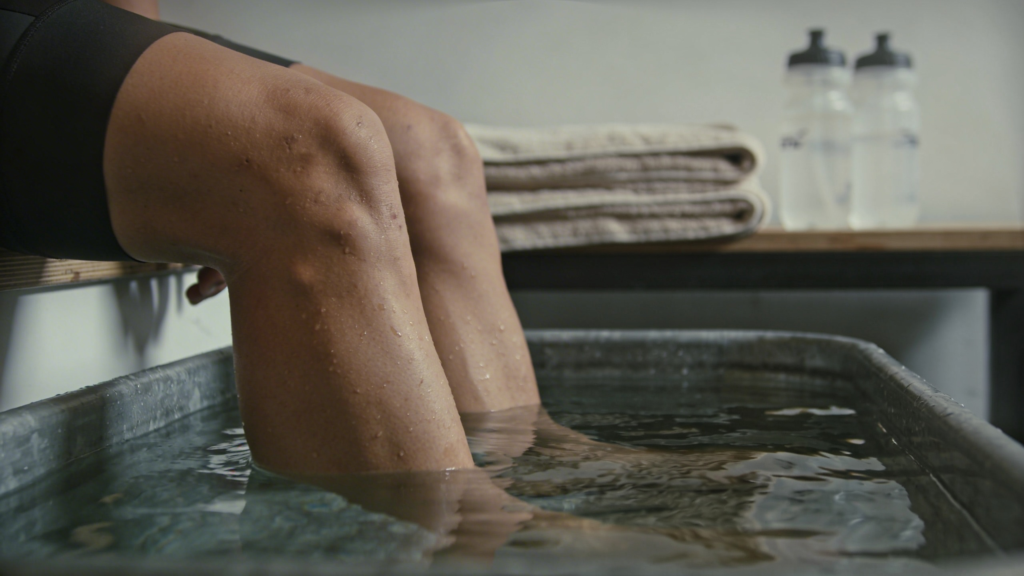
Use case one: post-ride recovery
This is the scenario most recreational cyclists picture: a hard training session, followed by cold water, followed by fresher legs the next day. The evidence is supportive but conditional.
CWI after a single hard ride reduces perceived soreness and can improve next-day readiness. A 2018 review in the Journal of Science and Cycling — one of the few reviews to examine cycling-specific recovery — found that CWI improved subsequent sprint power output and time trial performance, particularly in hot and humid conditions.
Timing within your training week is the practical question. If you’ve just completed a genuinely hard session and you need to perform again within 24 to 48 hours, cold therapy earns its place. Where it becomes less necessary: easy endurance rides, recovery spins, sessions that didn’t push you into significant fatigue. And if you’re in a dedicated training block where the purpose of the session was to generate adaptation stress — say, a VO2max interval day followed by two rest days — there’s no urgency to accelerate the process. This is where ice bath periodisation becomes important.
For post-ride use: water temperature between 10 and 15°C, immersion for 10 to 15 minutes, ideally within 30 minutes of finishing. A recent network meta-analysis identified 9–12°C for 10–15 minutes as the optimal window for endurance recovery specifically — a different recommendation from the colder, shorter protocols sometimes suggested for strength sports.
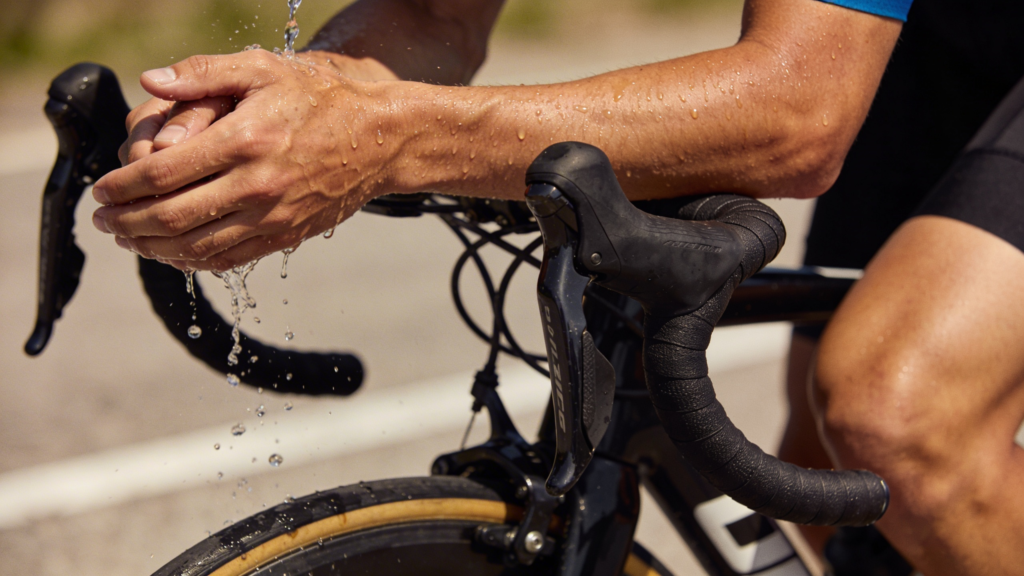
Use case two: multi-stage and multi-session recovery
Here, the evidence is strongest — and CWI moves from ‘helpful if convenient’ to ‘hard to replace.’
The scenario is familiar to any cyclist who has ridden a multi-day event: a sportive weekend, a training camp, a stage race. You finish day one knowing that day two will ask the same from your legs, or more. The question isn’t whether you’ll adapt from the effort — it’s whether you can produce equivalent output tomorrow.
A 2008 study testing repeat cycling performance in 34°C heat, conducted by Vaile, Prof Shona Halson, and colleagues at the Australian Institute of Sport, provides the clearest data point. Cyclists completed high-intensity efforts on consecutive days. Those using CWI between sessions maintained their total work output. Those using active recovery alone saw a 4.1% decline. In competitive cycling, 4.1% is not marginal — it’s the difference between staying with the group and being dropped on the first climb. Halson, who later led the Olympic Recovery Centre, built much of the foundational evidence for CWI in this repeat-bout scenario.
The protocol here is slightly more aggressive than single-session recovery. Water at 10–12°C, immersion for 12–15 minutes, performed as soon as practically possible after each stage or session. Consistency matters more than precision.
Use case three: pre-cooling for heat
Most cyclists haven’t considered this use case, and it changes the framing of CWI entirely: from a post-effort recovery tool to a pre-effort performance strategy.
The logic, as environmental physiologist Dr Stephen Cheung has framed it: any time you are hotter than you need to be, you are not performing as well as you could be. In cycling, where sustained aerobic output generates enormous metabolic heat and the primary cooling mechanism (evaporative sweat loss) is compromised by humidity, starting a ride with a lower core temperature extends the window before thermal strain limits performance.
A 2008 Australian Institute of Sport study by Quod, Halson, and colleagues tested combined pre-cooling (cold water immersion plus a cooling jacket) before a cycling time trial in the heat. The result: a 1.8% improvement in time trial performance, equivalent to roughly 42 seconds. In a discipline where riders spend thousands on aerodynamic gains measured in single-digit seconds, that’s a substantial return from a non-equipment intervention.
Pre-cooling benefits become relevant once ambient temperatures climb above approximately 25°C, and they scale with heat and humidity. For cyclists riding in Mediterranean summers, tropical climates, or Middle Eastern heat, this is not a marginal consideration — it’s a primary performance lever.
In equatorial environments where ambient temperatures rarely drop below 28°C, the temperature differential when entering water at 6–8°C is dramatic: a drop of over 20 degrees that creates an especially pronounced physiological and perceptual cooling response. The heat isn’t just context for CWI in these settings; it’s what makes the intervention most effective.
The protocol for pre-cooling differs from recovery. Shorter immersion — 5 to 10 minutes — at 10–15°C, performed 20 to 40 minutes before the start. The aim is to lower core temperature without triggering the vasoconstriction and shivering that would impair warm-up quality. Some riders combine brief immersion with a cooling vest worn during warm-up, extending the thermal advantage to the start line.
Protocols at a glance
Post-ride recovery (single hard session, next-day performance matters) Water temperature: 10–15°C. Duration: 10–15 minutes. Timing: within 30 minutes of finishing. Skip it after easy rides or when you have two-plus days before the next effort.
Multi-stage or multi-session recovery (training camps, stage races, back-to-back event days) Water temperature: 10–12°C. Duration: 12–15 minutes. Timing: as soon as possible after each stage. Consistency across days is what makes multi-day recovery protocols effective.
Pre-cooling for heat (time trials, road races, or hard rides in temperatures above 25°C) Water temperature: 10–15°C. Duration: 5–10 minutes. Timing: 20–40 minutes before the start. Combine with a cooling vest during warm-up if available.
Across all three scenarios, reliable water temperature matters more than the vessel. A purpose-built unit that holds a set temperature eliminates the guesswork of ice-and-water ratios in improvised setups, but any container that gets you to the right range and keeps you immersed to mid-torso will do the job. Cold showers can ease thermal load after a hot ride but lack the hydrostatic pressure and consistent temperature of full immersion — for multi-stage and pre-cooling use, they’re not a substitute. Contrast therapy (alternating cold and warm water) is a viable option for riders who find full CWI unpleasant, though the cycling-specific evidence is thinner.
The tool and its context
The confusion around ice baths and cycling was never about ice baths. It was about a finding from one branch of exercise science applied, uncritically, to a sport it was never tested on. The endurance-specific research tells a completely different story — one where cold water immersion supports rather than sabotages cycling performance.
Three clear applications, each with its own protocol, each supported by cycling-specific evidence. Post-ride when tomorrow matters. Between stages when cumulative fatigue is the enemy. Before the start when heat is the constraint. The fear that kept many cyclists from using CWI was real, but it belonged to a different sport.


