
It’s 4pm, you’ve just finished sparring, your shins are swelling, your hands are tight, and you’ve got a strength session at seven tomorrow morning. Do you get in the ice bath or not?
Your answer depends on where you are in camp, what you just trained, and what you’re training next. The ice bath is one of the sharpest recovery tools in MMA, boxing, and BJJ. It’s also one of the most misused, because almost every protocol you’ll find online treats it as a single prescription: 10–15 minutes, 10–15°C, repeat daily. That ignores the reality of how fighters train. Multiple sessions per day. Radically different modalities. A body composition deadline looming at the end of it all.
What follows is a phase-by-phase framework, grounded in three studies that used MMA and BJJ athletes as subjects, covering the one question no other article touches: what happens when you combine cold water immersion with a body that’s already dehydrated and depleted from cutting weight.
The Evidence That Actually Uses Fighters
Most CWI advice for combat athletes is borrowed from team sport or endurance research. But fighters absorb a training load those populations don’t: direct impact to muscle tissue, repeated blunt trauma to limbs, high-intensity grappling that creates a distinct pattern of damage. Three published studies have measured CWI effects in fighters specifically.
Angus Lindsay, a sports and exercise science researcher, and colleagues (2017) immersed MMA athletes in 10°C water for 15 minutes after a full training session of striking, grappling, and sparring. Cortisol dropped. Neopterin, a marker of oxidative stress tied to immune activation, dropped. Soreness fell at 2 hours and 24 hours, and countermovement jump performance was unaffected. What makes this study distinctive is its attention to ‘impact-induced stress’: the inflammatory response triggered by being kicked and thrown is mechanistically different from the inflammation of a squat session, and CWI appears well-suited to managing it.
Tabben et al. (2018) found that after simulated MMA combat, sprint performance was worse immediately after CWI but better at 24 hours. For fighters training multiple times per day, that finding changes how you plan your day.
Fonseca et al. (2016) studied jiu-jitsu athletes using an intermittent protocol: four rounds of four minutes at 6°C, with one minute out between rounds. Muscle damage markers dropped, soreness fell, and muscle power at 24 hours was preserved.
These three studies establish something no generic ice bath guide can claim: direct evidence in fighters. They anchor the phase recommendations that follow.
The Phase-by-Phase Framework
Off-Camp: Build the Base, Skip the Bath
When you’re not preparing for a specific fight, your training priorities shift toward strength, lean mass, and structural resilience. CWI can actively work against you here.
Roberts et al. (2015) demonstrated that regular cold water immersion after resistance training attenuated satellite cell activity and the signalling pathways responsible for muscle growth. Long-term strength and hypertrophy gains were blunted. A 2024 meta-analysis by Piñero and colleagues confirmed the effect holds across multiple studies: if you’re training to get stronger, habitual CWI after lifting undermines the adaptation you’re trying to create.
James de Lacey, a strength and conditioning specialist writing for Science for Sport, has argued that the Roberts findings, based on untrained individuals lifting three times per week, may not translate directly to fighters training three sessions per day across mixed modalities. The training density is different, the recovery demand is different, and the total systemic stress is different. That’s a fair point. But the underlying mechanism (cold suppressing the inflammatory signalling that drives muscle repair) is well established enough that the conservative approach makes sense during a dedicated strength phase.
Off-camp protocol: Use CWI sparingly, if at all. Reserve it for days dominated by hard striking or grappling with no strength work in the following 24 hours. After heavy squats, deadlifts, or upper-body hypertrophy sessions, leave it alone. Let the inflammation do its job.
Early Fight Camp: Selective, Not Habitual
Early camp typically blends strength maintenance with rising sport-specific volume: more pad work, more wrestling, more sparring. Everything hurts, and the temptation to ice bath daily is strongest here.
Resist it. Early camp is when the body is still making structural adaptations. CWI after every session will dull the soreness but may also dull the adaptation. A selective approach works better: cold water immersion after high-impact sessions, skipped after strength or conditioning work.
Tabben’s timing insight matters most here. Fighters in early camp often train twice or three times a day. The acute performance impairment Tabben documented, reduced explosiveness lasting several hours after immersion, means a morning ice bath could carry into your afternoon session. Save CWI for the final session of the day, when the next training block is at least 12–16 hours away.
Early camp protocol: 10–12 minutes at 10–15°C after the last session of the day, only on sparring or high-impact grappling days.
Peak Camp: When CWI Earns Its Place
The final three to four weeks before a fight are where training volume peaks and the body takes the heaviest cumulative beating. Sparring is hardest, rolling is most intense, and the focus shifts entirely from building capacity to maintaining readiness while managing damage.
Lindsay’s findings apply most directly at this stage. Impact-induced muscle damage, cortisol elevation, and accumulated soreness make post-sparring CWI the strongest recovery choice at this stage. You’re not trying to build new muscle. You’re trying to survive camp with your body intact enough to fight.
Fonseca’s intermittent protocol is worth considering here, particularly after hard grappling: four rounds of four minutes at around 6°C, with brief breaks between rounds. For grapplers and wrestlers carrying high training loads, this offers a way to manage damage without one continuous block in uncomfortably cold water. In gyms that run communal cold baths after sparring, the shared post-session immersion becomes part of the camp rhythm, an earned ritual that mirrors the culture of the sport itself.
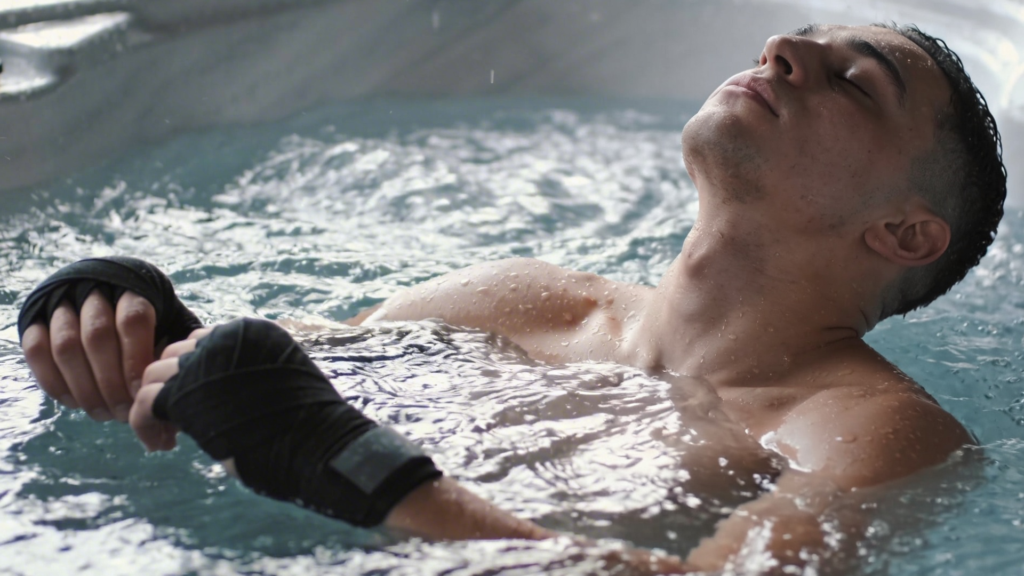
Peak camp protocol: 10–15 minutes at 10–15°C after sparring or high-volume grappling, daily if needed. The 2025 network meta-analysis of 55 randomised controlled trials found that 5–10°C is marginally better for biochemical and neuromuscular recovery while 11–15°C is better for perceived soreness reduction. Most fighters will benefit from something in the 10°C range as a practical middle ground.
Fight Week: Proceed with Extreme Caution
No other article writes this section. It should.
Fight week for weight-class athletes involves some combination of caloric restriction, water manipulation, and often sauna exposure to shed the final kilograms. The 2025 ISSN position stand on nutrition and weight management in combat sports documents the physiological reality: even a 2.5% bodyweight loss from dehydration impairs cardiovascular function, thermoregulatory capacity, and cognitive performance. Rapid weight loss protocols push many fighters to 5–8% bodyweight reduction in the final days.
No published study has examined the interaction between cold water immersion and a body in this state. That gap matters. Here’s what we know from adjacent physiology.
A dehydrated body has reduced blood volume. Cold immersion works partly by driving blood from the periphery toward the core through vasoconstriction. In a well-hydrated athlete, this is a controlled circulatory shift. In a significantly dehydrated athlete, the same shift may produce an exaggerated cardiovascular response: blood pressure spikes, reduced cardiac output, increased strain on a heart already working harder to circulate less fluid.
Glycogen-depleted muscles are already impaired in their ability to generate heat. Cold immersion in a calorie-restricted, glycogen-depleted state could drop core temperature faster and further than the same protocol would in a fully fuelled athlete. Your thermoregulatory safety margin is narrower.
And the psychological dimension: a fighter in the final stages of a hard weight cut is cognitively compromised, often irritable, sometimes disoriented. The decision-making required to self-regulate in cold water, knowing when to get out, recognising warning signs, may be impaired at the exact moment it matters most.
Fight week protocol: Do not use cold water immersion during active weight cutting. If you have already made weight and are rehydrating, a brief immersion at 12–15°C for 5–8 minutes may help manage residual soreness, but it should be supervised and deliberate, not a habit carried over from camp.
Post-Fight: Manage the Damage
After a fight, the body carries acute trauma (bruising, swelling, possible microfractures), systemic inflammation, and central nervous system fatigue. CWI is most straightforwardly helpful here and least likely to interfere with any training goal.
Lindsay’s finding that CWI after MMA training reduced cortisol and oxidative stress markers without impairing neuromuscular function applies here with even greater force. Post-fight cortisol is typically higher than post-training cortisol, and the accumulated impact damage is worse. There is no adaptation to protect, and the inflammatory load is high enough that the anti-inflammatory effect is purely beneficial.
Post-fight protocol: 12–15 minutes at 10–12°C within two hours of the fight if practically possible, with a second session the following day.
Tournament Day: Between-Bout Recovery
Jiu-jitsu competitors, amateur boxers, and wrestlers often fight multiple times in a single day. The recovery window between bouts might be 30 minutes or three hours. The Tabben timing constraint applies here directly: if your next bout is within three hours, skip the ice bath.
If the gap between bouts exceeds four hours, a brief, moderate immersion may help manage soreness and perceived fatigue without carrying the acute performance penalty into the next match. But the evidence base is thin, and the conservative approach is to rely on active recovery, nutrition, and rest between same-day bouts, saving CWI for after the final match.
Tournament protocol: Skip CWI between bouts unless the gap exceeds four hours. After your last match, follow the post-fight protocol.
Protocol Quick Reference
These numbers are drawn from the 2025 network meta-analysis, calibrated by the three combat-sport studies.
Temperature: 10–15°C for general recovery and soreness reduction. 5–10°C if prioritising deeper biochemical recovery (reduced inflammatory markers, faster neuromuscular restoration). Not colder than 5°C. The evidence doesn’t support it, and the stress response at near-freezing temperatures may be counterproductive. Many athletes default to 3–4°C assuming colder means better; the research says otherwise.
Duration: 10–15 minutes for continuous immersion. The Fonseca intermittent protocol (4 × 4 minutes at approximately 6°C with 1 minute out) is a viable alternative for grappling-heavy sessions.
Timing: After the final training session of the day. Not between same-day sessions. Not within three hours of the next bout or training block.
Depth: Submerge to the chest or shoulders. Lower-body-only immersion is less effective for managing the systemic inflammatory response combat athletes carry.
Skin condition note: Fighters with open cuts, mat rash, or significant abrasions should be aware that cold immersion can, in rare cases, trigger cold urticaria, a histamine-mediated skin reaction. Check with your team if you have active wounds.
Equipment consistency: Fight camps running three sessions per day benefit from temperature-controlled setups. When the protocol calls for 10°C, it needs to be 10°C, not a bin of melting ice that started at 4°C and ended at 16°C. Protocol consistency is what separates a recovery tool from a ritual that just feels hard.
Closing
The ice bath is not a daily habit. It’s a decision that changes with the phase, the session, and the state of your body. The same protocol that accelerates recovery after Thursday sparring can blunt the strength gains from Monday’s squats. The tool that keeps you training through peak camp becomes a genuine risk when you’re dehydrated and depleted on fight week.
Fighters already think in phases. Periodisation is how you plan training load, caloric intake, sparring intensity, and taper. Cold water immersion demands the same discipline. Use it when the evidence says it helps. Skip it when the evidence says it might cost you. And during the days when your body is at its most compromised, respect what you don’t know.


