About Your Chiller
A detailed look at the engineering inside the icebaths.com chilling machine. What each component does, why it was chosen, and how it all works together.
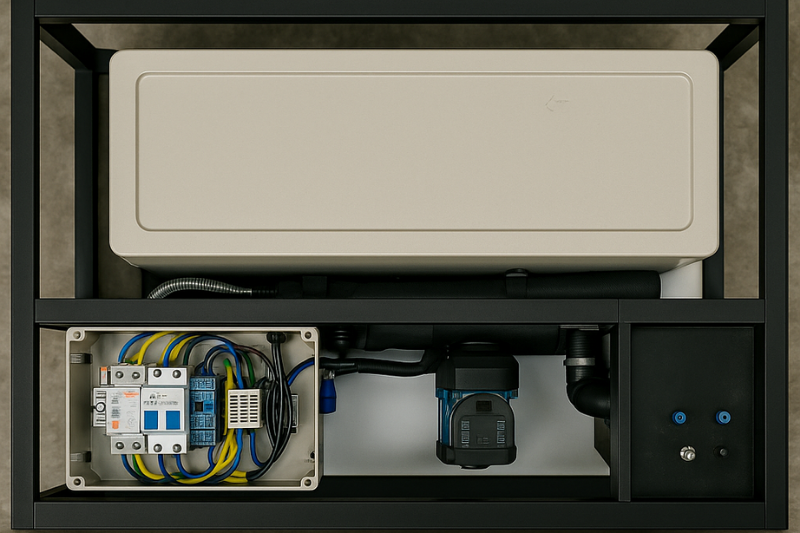
Who is this for?
Anyone who wants to understand what is inside their chiller and how it works. This is not a maintenance guide. For maintenance instructions, see the chiller maintenance page. For water care, see the water maintenance guides.
What the Chiller Does
The basics of what the chiller is responsible for, in plain terms.
The chiller has three jobs: cool the water, clean the water, and circulate the water. It does all three continuously and automatically while it is plugged in.
Water flows from the ice bath into the chiller through one hose. Inside the chiller it passes through a filter (which catches debris), a UV disinfection chamber (which kills bacteria), and a cooling coil (which drops the temperature). The pump then pushes the now cold, clean water back into the bath through the second hose. This cycle repeats continuously.
On the Barrel and Column models, the chiller circulates the entire volume of water every 6 minutes. On the Cube, every 8 minutes. This means the full body of water passes through filtration, disinfection, and cooling roughly 10 times per hour.
What Is Inside
A breakdown of every major component inside the chiller and what it does.
The Pump
The pump is the engine of the system. It drives water through every other component. Without sufficient pump power, the water moves too slowly, cooling is inefficient, filtration is weak, and stagnation becomes a risk.
We use a custom Wasser PB169EA industrial pump. It is designed for continuous 24/7 operation and has both suction and pressure functions. This means it can handle air pockets in the line without cavitating. Cavitation is when air gets trapped in the pump and causes it to lose flow or fail entirely. It is one of the most common failure points in cheaper chilling machines that use small aquarium pumps.
Many chillers on the market use aquarium pumps because they are small, cheap, and quiet. The trade-off is that they move water slowly, they struggle with air in the line, and they are not designed for the demands of continuous operation. A 1HP chiller with a powerful industrial pump will cool water faster and more reliably than a 3HP chiller with a weak pump. The pump matters more than the headline HP number.
The Compressor
The compressor is what generates the cooling. It compresses refrigerant gas, which releases heat on one side (this is why the chiller expels warm air) and absorbs heat from the water on the other side.
We use a Daikin Thailand STC25NV14 compressor rated at 1HP. Daikin is one of the most respected names in cooling and air conditioning worldwide. The compressor uses R32 refrigerant, which is more energy efficient and has a lower environmental impact than older refrigerant types.
At 1HP, combined with our pump and insulated bath design, the system cools water from ambient room temperature to 3 degrees Celsius in approximately 5 hours with the lid on. Once at temperature, the compressor cycles on and off via the thermostat to maintain your target. It does not run continuously.
The Evaporator
The evaporator is the cooling coil where the actual heat exchange happens. Cold refrigerant flows through the coil while water flows over it. The water loses heat to the refrigerant and returns to the bath colder.
We use a titanium tube evaporator rated for 1HP. Titanium is used because it is highly resistant to corrosion from constant water exposure and temperature cycling. Cheaper alternatives use copper or aluminium, which corrode faster in cold water environments.
The Particle Filter
Before water reaches the pump or any other component, it passes through a stainless steel mesh particle filter. This catches physical debris like hair, skin cells, dust, and small particles. It prevents these from entering the pump, clogging the system, or reducing the effectiveness of the UV disinfection.
The filter sits inside a clear housing (so you can visually check its condition) with a screw-off cap accessed from the rear of the chiller. It is designed to be cleaned and reused. Each unit comes with 4 filters. Full filter maintenance instructions are in the water maintenance guides.
The UV-C Disinfection Light
After filtration, water passes through a UV-C disinfection chamber. This is a 16-watt ultraviolet light that destroys bacteria, viruses, and microorganisms as water flows past it. It is completely chemical-free and works continuously while the chiller is running.
This is the same technology used in hospital water purification and municipal water treatment. It is effective across the full temperature range of the ice bath. Unlike chlorine or ozone, UV-C leaves no residue, no chemical smell, and nothing that makes contact with your skin. The only maintenance required is replacing the bulb approximately every 2 years (see the chiller maintenance guide for details).
The Electronics
The control electronics are housed in a waterproof enclosure rated IP67. This means the electronics are protected against full immersion in water, not just splashes. This level of protection is critical for units installed outdoors in tropical climates where heavy rain, humidity, and condensation are constant factors.
Inside the electronics box:
Safety circuit breaker (ELCB 10A). Protects against electrical faults and earth leakage. This is a safety device that cuts power immediately if it detects a fault.
Smart switch. Connects to the Tuya Smart app for WiFi temperature control. This is how you set and monitor temperature from your phone.
Digital thermostat. Monitors water temperature via a sensor inside the chiller and tells the compressor when to turn on and off.
ATorch power monitor. Displays real-time voltage, current, and power consumption. This allows you or a technician to verify the electrical supply is within safe limits (210 to 240V, 3.8 to 4.8A, under 2,300W).
Manual thermostat option. Not every installation has reliable WiFi. We also offer a manual thermostat version of the chiller that does not require an internet connection. You set the target temperature directly on the unit. Same cooling performance, same components, just without the app control. Contact the team if you prefer this option.
Specifications
| Specification | Detail |
|---|---|
| Cooling power | 1HP commercial-grade |
| Compressor | Daikin Thailand STC25NV14 |
| Pump | Wasser PB169EA industrial (suction and pressure) |
| Evaporator | Titanium tube, 1HP rated |
| Refrigerant | R32 (eco-friendly, energy efficient) |
| Temperature range | 3 to 7 degrees Celsius (customer controlled) |
| Cooling time | Approximately 5 hours from ambient to 3 degrees with lid on |
| Water circulation | Full volume every 6 minutes (Barrel/Column), 8 minutes (Cube) |
| UV disinfection | 16W UV-C, chemical-free, continuous while chiller is running |
| Filtration | Stainless steel mesh particle filter (reusable) |
| Noise level | 52 decibels (comparable to a quiet conversation) |
| Power consumption | 1,300 watts (similar to a medium air conditioner) |
| Power supply | 220V standard outlet, any plug type installed for your region |
| Waterproof rating | IP67 (electronics enclosure) |
| Dimensions | 86cm (L) x 57cm (W) x 59cm (H) |
| Hose length | Standard 1m, extendable up to 5m |
| Power cord | Standard 2m |
| Control | WiFi (Tuya Smart app) or manual thermostat |
| Cover | Matching teak wood cover as standard. Also available without cover. |
How Temperature Control Works
How the chiller maintains your target temperature automatically, and how you interact with it.
Once the chiller is plugged in and the water is filled, the system operates on a simple cycle. The thermostat continuously monitors the water temperature via a sensor inside the chiller. When the water is warmer than your target temperature, the compressor turns on and begins cooling. When the water reaches the target, the compressor turns off. The pump continues to circulate water even when the compressor is off, keeping the water moving and maintaining even temperature throughout the bath.
This is called Autowork mode. It should be left on at all times. It prevents the compressor from overworking, saves electricity, and extends the life of the system.
WiFi control (Tuya Smart app)
If you have the WiFi-enabled version, the Tuya Smart app allows you to:
See the current water temperature in real time.
Set your target temperature.
Turn Autowork mode on or off (always leave it on).
Monitor power consumption.
Control the chiller remotely from anywhere.
The app setup is done during installation. If you need to reconnect or reset the WiFi, there is a reset process via the control panel inside the chiller (Option 18: WiFi Device Reset). Full app setup instructions are provided during installation and are available on icebaths.comm/resources.
Manual thermostat
If you have the manual thermostat version, you set the target temperature directly on the unit using physical controls. The system operates identically in terms of cooling performance. The only difference is that you cannot monitor or adjust the temperature remotely.
Why Cold Only
We are sometimes asked why we do not offer a heating option. Here is the engineering reasoning.
Every component in the chiller is purpose-built for cold water therapy. The compressor, the pump, the evaporator, the piping, and the insulation are all optimised for one thing: delivering consistently cold, clean water.
When manufacturers add heating capability to a cold water system, they have to use components that handle both temperature extremes. This introduces compromises in both directions. The cooling is less efficient, the heating is less efficient, and the thermal stress on components from cycling between hot and cold shortens their lifespan.
Our approach is to do one thing and do it well. Our standard 1HP system matches or exceeds what many competitors label as their “commercial grade” offering. That is because every component is engineered specifically for cold water performance, with no compromises for heating functionality it will never need to perform.
If you want both hot and cold therapy, the most effective approach is a dedicated ice bath alongside a separate hot tub or sauna. Each system performs at its best when it is designed for a single purpose.
How We Got Here
A brief note on why we build our own chiller rather than importing one.
When icebaths.com started in 2022, the focus was on designing beautiful teak ice baths. The chiller was an afterthought. We initially imported chilling machines from China, expecting them to perform as specified. Within weeks, problems emerged. Undersized pumps that could not maintain flow. Substandard welding that leaked under thermal cycling. Electronics that failed in humid conditions. Pumps that cavitated when air entered the line.
That experience taught us that the chiller is not a commodity component you bolt on. It is the core of the system. Since then, we have spent four years manufacturing our own chilling machines in our factory in Bali. We have iterated and changed components over 100 times to arrive at the current design.
Every component is selected, tested, and assembled by our team. We use a Daikin compressor from Thailand, not a generic unit. We use a custom industrial Wasser pump, not an aquarium pump. We use a titanium evaporator, not copper. We use IP67 waterproof electronics, not a basic enclosure. We know every part inside this machine because we built it.
This is why we can offer on-island servicing, stock every spare part, and diagnose issues remotely. We did not buy a product from a factory. We are the factory.
Need Help?
If you have questions about your chiller, its specifications, or how it works, our team is here to help.
WhatsApp wa.me/6287774080206
Email hello@icebaths.com