
Five things keep gym owners from pulling the trigger on a cold plunge: where it physically goes, who keeps the water clean when staff can barely stock soap, how to price it without triggering cancellations, what the insurer actually covers, and how to introduce it to members who chose the gym because it was affordable. If you’re working out how to add a cold plunge to your gym, know this: the equipment is the simplest decision you’ll make. The rollout strategy, maintenance commitment, and revenue model determine whether this becomes a centrepiece or a drain.
This is the operational playbook: six phases, real numbers, honest warnings. It draws on commercial installation data and one of the most detailed franchise rollout case studies in the industry. Work through it in sequence.
Phase 1: Assess — Space, Infrastructure, and Demand Signals
Before you price a single unit, answer three questions: do you have the floor space, can your building support it, and is there enough latent demand to justify the investment?
Space footprints worth memorising. A single cold plunge tub needs roughly 48 square feet including clearances — an 8-by-6-foot rectangle that accounts for access, drainage, and a small step-out area. A two-to-three person zone with a rest bench runs 150 to 220 square feet. A full recovery corner with sauna and lounge seating: 400 to 800 square feet. Undersizing creates bottlenecks that kill utilisation within weeks.
Proximity matters more than you’d expect. Position the plunge near existing showers and, if you have one, your sauna. For contrast therapy to work practically, the path from heat to cold should take under ten seconds. Members who have to walk through the main gym floor in a towel will stop using it. You also need drainage: cold plunge zones produce splash, overflow, and condensation. If your best available space is carpeted and far from a drain, the retrofit costs may change your calculation entirely.
The infrastructure problems that appear after installation. From our experience across commercial gym installations, two issues recur in facilities that skip this step. First, electrical capacity: a commercial chiller draws significant power, and in older buildings or tropical climates we’ve seen voltage fluctuations damage units within months — one installation in Southeast Asia required dedicated voltage stabilisers before the chiller would run reliably. Second, humidity: in any enclosed space, a cold plunge generates persistent condensation that accelerates corrosion of nearby equipment and surfaces. Ventilation and dehumidification aren’t cosmetic upgrades — they’re operational necessities.
Demand signals. Survey your members, but weight other indicators more heavily: how many already shower after training (they’re in a recovery mindset), whether your local market has cold plunge studios charging per session (demand exists and you can capture it), and whether competitors have added recovery amenities. A gap between 15% and 50% interest changes everything about your pricing model.
Phase 2: Plan — Budget, Revenue Model, and Compliance
Most gym owners stall here, because the decisions compound. Take them one at a time.
Layout note. If your facility has gender-segregated changing rooms and you want the plunge accessible to everyone, you’ll need either two units or a unisex recovery area with adequate privacy. This decision shapes your budget and floor plan before equipment selection begins.
Revenue Models: Worked Numbers
Three models dominate, and each suits a different type of gym.
Premium tier access works best for mid-market gyms with 300+ members where a meaningful percentage will pay for exclusivity. You add cold plunge to an upgraded membership tier priced $10 to $20 above standard dues. The Snap Fitness case study is the clearest proof point: after adding a recovery zone, the franchise location increased dues by $10 per month (from $49.95 to $59.95) and lost only two members. With 200 members at the higher tier, that’s $24,000 in additional annual revenue from the price adjustment alone, before accounting for the 220 net new members the location attracted in eight months.
Per-session pricing suits boutique or low-volume facilities where the plunge is positioned as a standalone service. Typical rates run $15 to $25 per session, but this model caps your revenue to utilisation and works only when walk-ins and non-members represent a genuine revenue stream.
Universal access with a small dues increase is the simplest approach for independent gyms with price-sensitive members. Raise everyone’s dues by $2 to $3 per month and position the plunge as a membership upgrade. With 400 members, a $3 increase generates $14,400 annually — enough to cover maintenance and begin recouping equipment costs within 18 to 24 months.
Compliance and insurance — the honest answer. There is no universal rule. Some gym-specific insurers include cold plunge coverage as standard within their general liability policies. Others explicitly exclude it. Dan Uyemura, who founded both PushPress and GymInsurance.com, runs a platform that covers cold plunge automatically, but competing providers like Sadler Sports categorise it as an exclusion. Call your insurer before you buy equipment. Ask specifically about cold water immersion, not just “wellness amenities,” because the classification matters.
Local health departments add another layer. In some jurisdictions, a cold plunge is classified as a spa pool, triggering registration, periodic inspections, and specific water quality standards. In others, it falls under general gym equipment with no special obligations. Budget two to four weeks for this step — getting the paperwork wrong is more expensive than getting the chiller wrong.

Phase 3: Build — Installation and the Design Choices That Affect Adoption
The details that seem cosmetic are often the ones that determine whether members use the plunge daily or treat it as expensive furniture.
Equipment Framework, Not Equipment Recommendation
This isn’t a buying guide (that’s a separate resource). Your selection criteria should be shaped by three realities: daily throughput estimate, staffing model (more on this in Phase 5), and space constraints. A single-user tub with an integrated chiller suits facilities expecting 15 to 25 plunges daily. High-throughput venues need external chillers with greater cooling capacity. At the W Hotel property we supply, the system handles 50-plus plunges per day without temperature recovery issues. Match the equipment to the demand, not the other way around.
What Scales Down from a Premium Installation
In our NXT Fit Jakarta project, we installed four Cube units across gender-segregated changing rooms, with chillers concealed beneath custom teak platforms and the layout designed from the architect’s drawings before construction began — cold plunge as an integrated architectural element rather than an aftermarket addition.
Those principles transfer to a 3,000-square-foot independent gym. Concealing the chiller — even behind a simple partition — reduces noise on the gym floor and makes the space feel intentional rather than improvised. Designing the zone before installation, even with painter’s tape on the floor, prevents the “we just put it where it fit” problem that tanks utilisation.
Design Choices That Drive Daily Use
Based on what we see across commercial installations and member behaviour data, five factors clearly separate a plunge that gets 20 uses a day from one that gets 3.
Privacy dividers, even a half-height frosted panel, reliably increase usage among members who feel self-conscious in minimal clothing. Clear step-by-step signage with a QR code linking to a short tutorial video reduces the “I don’t know what to do” barrier that stops first-timers, and cuts the burden on your staff. Warm, slightly dim lighting signals “recovery space” rather than “clinical treatment room.” A small rest area with seating nearby encourages members to stay longer post-plunge, which correlates with longer overall visits and higher retention. And clean wet/dry zone separation, with adequate drainage and a clear boundary from the gym floor, prevents the facility from feeling chaotic and reduces your daily cleaning load.
Phase 4: Launch — The Rollout Strategy That Makes or Breaks You
Every other guide goes silent here. You’ve built the thing. Now you need to introduce it without triggering a revolt, price it without haemorrhaging your base, and build enough usage momentum that the plunge becomes self-sustaining.
Snap Fitness’s phased recovery zone launch remains the best documented rollout in the industry. Snap chose dry cold therapy (CryoLounge chairs) rather than wet plunge — specifically to avoid the maintenance complexity — but the rollout strategy itself transfers directly. Even a 500+ location franchise took the maintenance question that seriously, which tells you everything about why this guide’s treatment of it matters.
Step one: renovate with clear communication. Before the plunge arrives, tell your members what’s coming and why. Snap closed sections of the gym briefly during renovation and used the disruption as a signal: “We’re investing in this facility.” For an independent gym, this might mean a two-week partial closure of the target area, with signage, emails, and social media posts building anticipation. Members tolerate disruption when they feel included in the upgrade story.
Step two: the 90-day free access window. When the plunge opens, every existing member gets free access for 90 days. No tier upgrade required, no per-session fee. That 90-day window is crucial: it removes the barrier to trial, generates the social proof of a busy recovery zone (nothing kills a new amenity faster than an empty one), and gives you 90 days of real utilisation data before you commit to a pricing model. Snap used this exact approach, and by the time the free window closed, the plunge wasn’t a novelty — it was part of the gym’s identity.
Step three: introduce pricing at a natural reset point. Snap timed their dues increase to January, the month when members are most psychologically ready for change and least likely to cancel. If your 90-day window lands differently, pick the nearest natural reset: a new quarter, an anniversary, a facility-wide membership review. If members have been using the plunge for three months, the ask feels fair.
Step four: staff training and member education. Of course, your front-desk staff need to answer three questions confidently: “Is it safe?”, “How cold is it?”, and “How long should I stay in?” They don’t need to be cold-water physiologists. They need a one-page briefing sheet and, ideally, to have tried the plunge themselves. In our commercial installations, we train reception staff as part of the setup, not on the science, but on the practical guidance that makes a nervous first-timer feel supported. This costs almost nothing and pays back directly in adoption rates.
How to Frame the Price
Based on the Snap data, the most effective approach is not “we’re adding a charge” but “we’ve expanded what your membership includes.” Snap positioned the $10 increase as an upgrade to a recovery-equipped membership, not a surcharge. Two cancellations. Nearly 220 new members in eight months.
For independent gyms using the universal small-increase model, the framing is simpler: “We’ve invested in a commercial recovery facility for you. Your membership now includes cold plunge therapy.” Most members who never use it will still value knowing it’s there, the same way they value having a sauna they visit twice a year.
Phase 5: Operate — Maintenance, the 24/7 Problem, and What Goes Wrong
If the maintenance section of a cold plunge guide feels light, the gym owner reading it knows the author has never run one.
Daily, Weekly, and Monthly Schedule
A commercially-oriented maintenance framework aligned with PWTAG (Pool Water Treatment Advisory Group) standards:
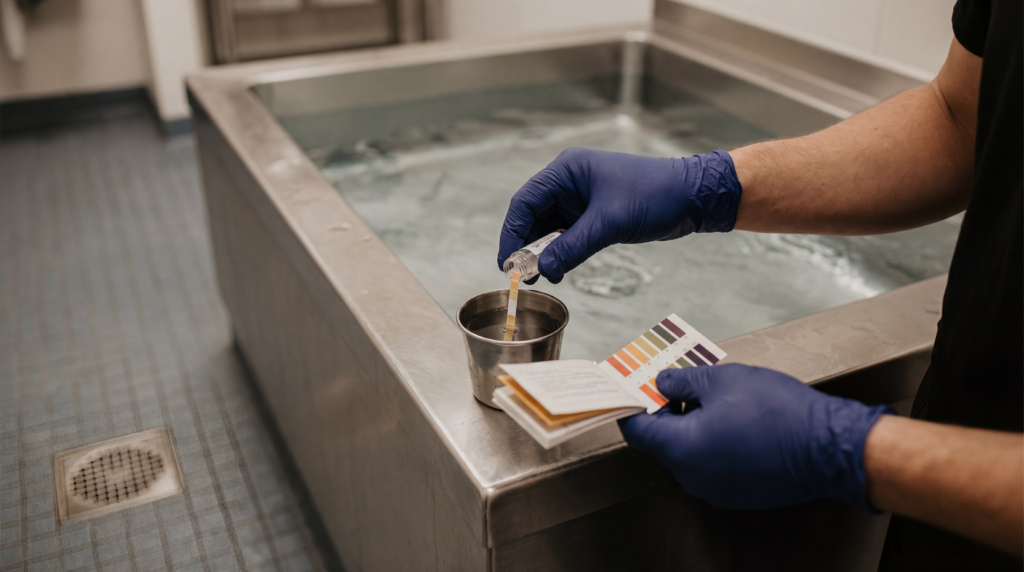
Daily: test water quality (pH 7.0–7.6, free chlorine 2–3 mg/l), remove visible debris, check water temperature, visually inspect the filter. Every other day under heavy use: clean or replace the particle filter. In a facility handling 20-plus plunges daily, filters degrade faster than manufacturers suggest — plan for replacement every 15 to 20 plunges, not the 40 to 50 that residential guidelines assume. Weekly: full water chemistry balance check, wipe down all surfaces around the plunge, inspect chiller operation and drainage. Monthly: send a water sample to a certified lab, flush the full system, drain and refill if chemistry has drifted beyond easy correction.
The Pre-Plunge Shower Problem
Every water quality guide assumes members shower before entering. In practice, enforcing this is one of the hardest operational challenges you’ll face. From our field observations, the facilities with the best water quality share two things: a shower positioned so close to the plunge that using it feels like part of the process rather than an extra step, and signage that frames the shower as “preparation” rather than “a rule.” Facilities that struggle tend to have the nearest shower around a corner, through a door, or in a separate changing room. Design solves the problem that rules alone cannot.
The 24/7 Unstaffed Gym Reality
Meanwhile, most modern independent gyms operate without staff for significant portions of the day. No manufacturer brochure addresses this honestly. Cold plunge in an unstaffed environment requires automated sanitisation systems that dose and circulate without human intervention, plus lockable insulated covers that prevent debris contamination and reduce energy costs during off-hours. Safety signage with emergency contacts and time-limit guidance must be visible from inside the plunge. If budget allows, a simple camera covering the plunge area — positioned for safety monitoring, not surveillance, with clear signage — adds a layer of protection.
Nobody catches a filter failure or chemistry drift during unstaffed hours, which is why automated monitoring systems that send pH and temperature alerts to your phone are worth the investment. A sensor-based alert system costs a fraction of what you’d spend draining, sanitising, and refilling a plunge that went bad overnight.
Throughput and Sizing
At the W Hotel property we supply, the system handles over 50 plunges per day with consistent water quality and temperature recovery, because the filtration and chiller were sized for the demand from the start. If you’re expecting 25 daily plunges and install filtration rated for 15, you’ll be draining the tub every three days instead of every month. Size for your realistic peak, not your average.
Phase 6: Optimise — What to Track and When to Expand
The Metrics That Matter
Track daily plunge count (a simple tally sheet works), monthly utilisation rate (plunges per day as a percentage of capacity), new membership attributions (ask every new member what attracted them), cancellation rate relative to your pre-plunge baseline, and maintenance cost per month. Review at 30, 60, and 90 days. At 30 days, the numbers will be inflated by novelty. The 90-day numbers tell you the truth.
When to Add Capacity
If your single unit is consistently at 80% or more of daily throughput at the 90-day mark, begin planning a second unit or an expanded recovery zone. If utilisation plateaus below 40%, the problem is almost certainly adoption (revisit Phase 4) or water quality (revisit Phase 5), not lack of demand.
The Pilot Mindset
Wendy White, CMO at Daxko, puts it precisely: “Pick one path and do a 90-day pilot, learn fast, and scale what resonates.” You don’t need a full recovery suite on day one. You need one properly installed, properly maintained cold plunge, a clear rollout plan, and 90 days of honest data.
The cold plunge itself is the smallest decision in this process. The owners who get it right don’t just add an amenity — they change what their facility means to their members. Start with a 90-day pilot. Learn fast.


