
There’s a particular kind of regret that comes with buying good equipment and putting it in the wrong place. The infrared sauna in the spare bedroom. The cold plunge in the garage. Forty feet of hallway between them, a dripping walk across cold tile, and a habit that quietly dies within the first month.
Most guides to contrast therapy at home start with what to buy. This one starts with where to put it. Proximity between your heat source and cold source is the single most significant variable that determines whether your setup functions as a system or degrades into two expensive appliances you occasionally use in isolation. Every equipment choice, every budget decision, every layout trade-off flows from this principle.
The proximity principle
Contrast therapy works through alternation. Heat expands your blood vessels, cold constricts them, and the rapid cycling between states drives blood flow, reduces inflammation, and accelerates recovery. A 2018 study led by Shadgan, using near-infrared spectroscopy to measure intramuscular hemodynamics, confirmed these tissue-level changes during contrast bathing.
But alternation requires transitions, and transitions are where home setups fail. When your sauna and cold plunge sit within ten to fifteen feet of each other, you step out and step in while your body is still fully heated. Stretch that transition to sixty or ninety seconds across a hallway and the contrast dulls, the physiological effect weakens, and the experience flattens into something merely inconvenient.
Before you choose a single piece of equipment, walk through your home and find the space where heat and cold can sit close enough that the shift between them feels like one continuous movement. A bathroom. A basement. A deck. A garage with exterior access. That space is your starting point.
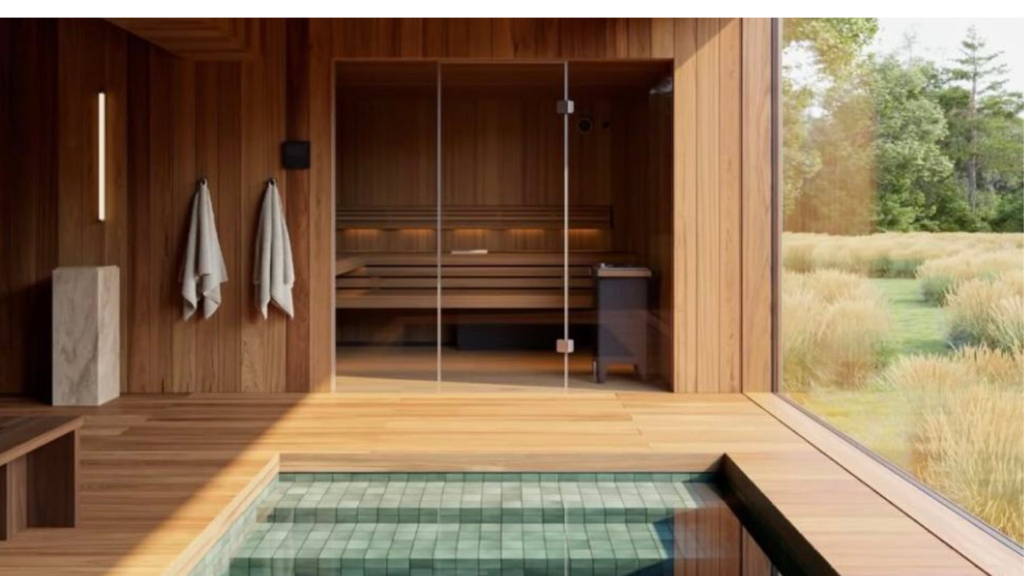
Three zones, not two appliances
A functional contrast therapy setup has three zones: heat, cold, and rest.
The rest space is the one almost everyone forgets. Between rounds, you need somewhere to pause, sit, breathe, and let your autonomic nervous system settle before you go again. A bench, a chair, a dry patch of deck with a towel. Even in a small bathroom running contrast showers, finishing a cold interval and sitting quietly for sixty seconds on the edge of the bath changes the experience from mechanical to contemplative.
The rest zone is what turns a protocol into a ritual. And rituals get repeated.
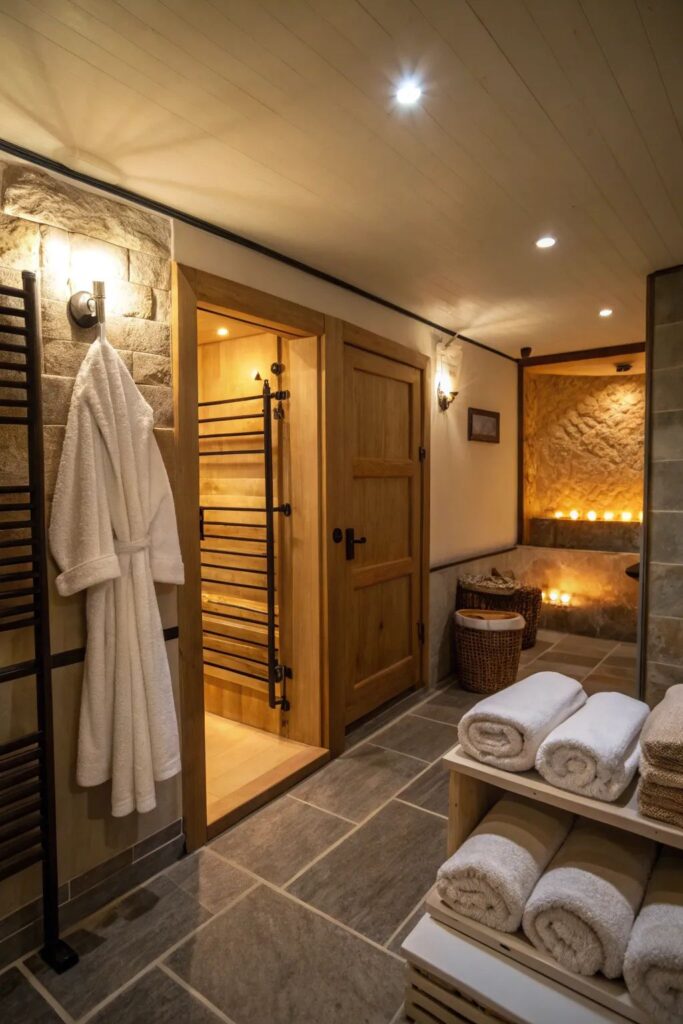
Tier 1: Contrast showers and your existing bathroom (£0–200)
You already own the simplest form of contrast therapy: a shower with temperature control.
Sebastian Kneipp, the nineteenth-century Bavarian priest who formalised hydrotherapy, established the method using alternating hot and cold water. A basic contrast shower follows the same logic: two to three minutes hot, thirty to sixty seconds cold, repeated for three to four rounds. It costs nothing and you can start today.
Contrast showers are a legitimate entry point. A 2014 study by Higgins, Greene, and Baker on elite netballers found clear improvements in perceived recovery from contrast showers, which matters more than it sounds. How recovered you feel determines whether you train again tomorrow.
But honesty requires two caveats.
First, the temperature problem. A “cold” shower is not a fixed stimulus. Mains water in northern Scotland might arrive at 8°C in winter. Mains water in Singapore or southern Spain sits at 24–26°C year-round. The word “cold” is doing very different work depending on where you live, and if you’re in a warm climate, a contrast shower may produce a mild temperature swing rather than the sharp alternation that drives the strongest response.
Second, the immersion gap. The same study that found perceptual benefits from contrast showers found that they did not accelerate physical recovery the way full-body immersion did. Hydrostatic pressure accounts for the difference: the gentle mechanical squeeze that water exerts on submerged tissue. Wilcock, Cronin, and Hing’s 2006 review of water immersion physiology found that this pressure causes measurable fluid shifts, reduces swelling, and increases cardiac output. A showerhead cannot produce this.
None of this makes contrast showers worthless. They build tolerance, establish a daily habit, and deliver the alertness and mood lift that cold exposure reliably produces. But the reader who treats a contrast shower as equivalent to a dedicated immersion setup is working from incomplete information. A bath thermometer (£5–10) will tell you what your mains water actually delivers. In many climates, the answer is humbling.
Tier 2: Portable plunge and existing or entry-level heat source (£2,000–5,000)
This is where full immersion enters the picture, and with it, genuine contrast therapy.
At Tier 2, the centrepiece is a cold plunge vessel large enough for full-body submersion: a purpose-built portable tub, a stock tank adapted for the purpose, or an entry-level plunge with a basic cooling unit. For heat, many people at this tier already own an infrared sauna panel, a garden barrel sauna, or have access to a gym sauna. The heat source doesn’t need to be new. It needs to be close.
If you already own a hot tub, it can serve as the heat element, though at lower temperatures than a sauna — typically 38–40°C versus 75–90°C — which means the thermal contrast is less pronounced. Wet heat at a lower temperature produces a different stimulus from dry or radiant heat at a higher temperature. It works, but expect a gentler swing.
Versey, Halson, and Dawson’s 2013 review of water immersion recovery methods found that contrast water therapy worked best with full-body immersion, short alternating intervals of roughly one minute each, and total session duration around fifteen minutes. Studies that failed to show benefits often used hot showers rather than immersion pools for the heat element. The research standard is immersion in both.
Without a chiller, temperature consistency becomes the clear limitation. You’re relying on ice, and ice introduces variability. A bag of ice drops water temperature quickly but unevenly, and as it melts, the temperature drifts upward throughout the session. You might start at 5°C and finish at 12°C. On hot days the drift accelerates, and the economics of buying ice stop making sense within weeks.
Dr Babak Shadgan, a physician and researcher at the University of British Columbia who has studied contrast bath hemodynamics, identifies exactly this tension. As Shadgan has noted, “at-home contrast bathing can help alleviate muscle soreness, improve circulation, and support recovery,” but it “may not be as precisely controlled as in a clinical setting.” That gap in precision is largely a gap in temperature control, and it’s what the next tier closes.
A basic plunge next to a barrel sauna on the same deck will outperform a premium cold plunge in the basement and a sauna in the garden. At this tier, layout is your most valuable investment.
Tier 3: Chiller-equipped plunge and dedicated sauna (£5,000–15,000+)
This is the tier where temperature becomes a fixed variable rather than something you manage.
A chiller-equipped cold plunge maintains a consistent temperature, session after session, without ice, without preparation, without drift. You set it to 6°C and it stays at 6°C whether it’s January or August, whether you used it yesterday or last week. The friction disappears: no ice runs, no waiting, no wondering whether the water is cold enough today.
Most buyers don’t know about a hard engineering constraint. Water inside a chiller unit approaches freezing below approximately 3°C, which creates a practical floor. But this rarely matters. Across actual user data, roughly 70 per cent of regular cold plunge users settle between 5°C and 10°C. Social media’s extreme-cold content represents the minority practice. Most people find their working temperature somewhere warmer than they expected.
For heat, the premium tier typically means a dedicated sauna. Whether you choose traditional Finnish, infrared, or barrel matters less than two factors: reliable heat output reaching and holding 75–90°C, and proximity to the cold plunge. The best home setups replicate the spatial logic of well-designed commercial environments like the Rekoop “Sweat and Freeze” concept, which places infrared heat and cold plunge within a single compact footprint so the transition requires a single step. You don’t need to replicate a commercial fit-out. But the principle is identical.
At this budget, how the space looks starts to affect how often you use it. Visible chillers, exposed hoses, and industrial fittings erode the feel of a space over time. Equipment that integrates into its environment becomes part of the home’s architecture; equipment that looks bolted on becomes something you tolerate, then avoid.
Plan the layout and the three zones before selecting equipment. Consider electrical requirements early: a chiller and an electric sauna heater on the same circuit will likely need a dedicated supply, and in many jurisdictions this requires a qualified electrician. Budget for drainage near the plunge, because a floor drain or exterior outlet will simplify maintenance for years.
Indoor, outdoor, and the climate question
Cold immersion outdoors, particularly in the morning, produces a quality of alertness that an enclosed room doesn’t match. The sky, the air, the light. For many people this experiential advantage outweighs practicality. But climate has the final word.
In hot and humid regions, an outdoor chiller must work substantially harder to maintain target temperatures. A plunge in direct sun in a tropical climate faces continuous thermal load from ambient air and solar radiation. Energy consumption rises, the chiller’s lifespan may shorten, and water temperature can struggle to hold on the hottest days. In these climates, shade or an indoor location may be necessary for the system to function as designed.
Cold climates present the opposite challenge: an outdoor plunge may require freeze protection for plumbing, and an exposed path between stations becomes genuinely unpleasant in wind and rain. A covered, sheltered transition matters.
A basement, where one exists, offers the most thermodynamically stable option in any home. Cool year-round, insulated from weather extremes, often with existing plumbing and drainage. For a chiller, stable ambient temperature means less work, quieter operation, and longer life.
What matters is which configuration keeps all three zones close together and practical in your specific climate, twelve months of the year.
What actually separates a setup that works from one that doesn’t
Layout comes first. Ten to fifteen feet between heat and cold, no doors between stations, a rest area within reach. This matters more than any single piece of equipment.
Temperature consistency comes second. A setup that delivers the same cold temperature every session, without preparation and without drift, removes the friction that causes people to skip days and then skip weeks. Ice works. A chiller works better. A contrast shower works with whatever your plumbing delivers, and you should know what that temperature actually is.
Equipment comes third. Not because it’s unimportant, but because premium equipment in a poor layout loses to modest equipment in a good layout, every time. Someone with a barrel sauna and a basic plunge five feet apart on their deck, used four mornings a week, is getting more from contrast therapy than someone with a beautifully engineered setup split across two rooms and used twice a month when motivation strikes.
Contrast therapy at home is achievable at every budget. A contrast shower tonight costs nothing and teaches you something real about how your body responds to temperature alternation. A dedicated immersion setup, planned around proximity, turns that response into a practice you sustain for years. The question was never really what to buy. It was where to put it.


