
Frequent sauna use is linked to a 40% reduction in all-cause mortality. That finding, from a 20-year study of 2,315 Finnish men published in JAMA Internal Medicine, is the single most cited piece of sauna-health evidence in the world. That study is almost certainly behind whatever claim convinced you that your sauna is good for your heart. But here is the detail that rarely makes it into marketing copy: every participant used a traditional Finnish sauna at approximately 80°C. Not an infrared cabin. A hot, wood-lined room where water is thrown on stones.
When you’re comparing infrared sauna vs traditional sauna for contrast therapy, that distinction changes the entire conversation. If you are choosing a heat source to pair with cold water immersion, you deserve to know where the research actually comes from.
How each sauna type heats the body
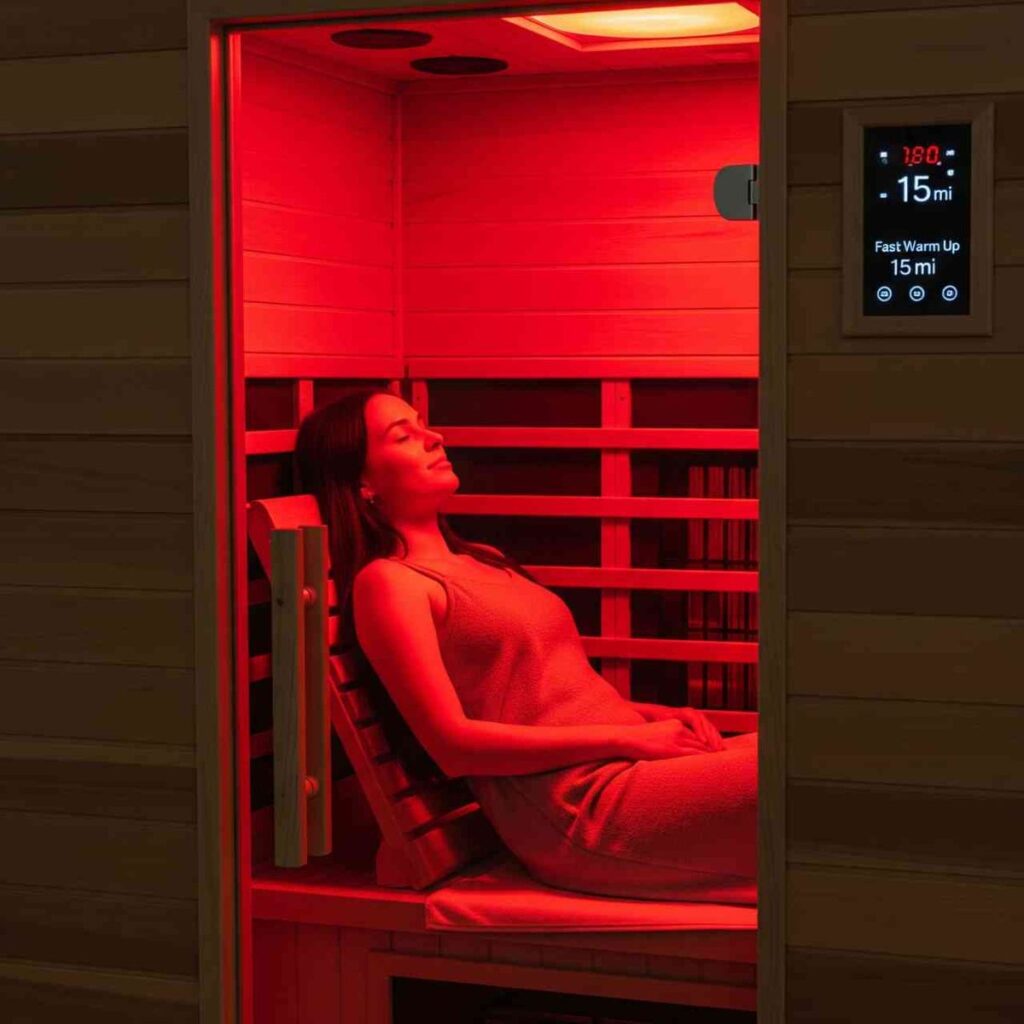
A traditional Finnish sauna heats the room to 80–100°C using an electric or wood-fired stove, often with stones that accept water to produce steam (löyly). Your skin temperature rises fast, your core temperature follows, your heart rate climbs. An infrared sauna uses far-infrared panels to heat the body more directly at lower air temperatures, typically 45–65°C. You still sweat and your heart rate still rises, but the overall thermal load is lower per minute of exposure, and most people find it significantly more tolerable.
Both produce a cardiovascular stress response. The question is whether that response is equivalent when the sauna is being used as the hot half of a hot-cold alternation protocol.
Where the landmark evidence actually comes from
Sauna evidence is not evenly distributed between types. Understanding this is the single most important thing you can do before choosing a sauna for contrast therapy.
The cardiovascular longevity data is traditional. Jari Laukkanen, the Finnish cardiologist behind the KIHD cohort study, tracked sauna habits alongside cardiovascular outcomes for over two decades. Men who used a sauna four to seven times per week showed a 63% lower risk of sudden cardiac death compared with those who went once a week. Its extended findings explicitly state that the conclusions “cannot be directly applied to other type of steam rooms and warm water therapy which may operate at lower temperatures.” That is not an inference. It is the researchers’ own caveat.
The contrast therapy data is traditional. Susanna Søberg, a metabolism researcher at the University of Copenhagen, produced the most widely referenced contrast therapy protocol in a 2021 study of experienced winter swimmers in Denmark. Her participants used approximately 11 minutes of cold water and 57 minutes of sauna per week and showed altered brown adipose tissue activation and improved thermoregulation. Søberg’s protocol used traditional sauna heat. A practitioner summary from WellFounded.health confirms the pattern: contrast therapy studies typically use sauna at 80–90°C paired with cold water at roughly 12°C.
The infrared evidence base is real but limited. A 2009 review in Canadian Family Physician found “limited moderate evidence” for far-infrared sauna benefits in blood pressure and heart failure. The studies were small, short-term, and largely conducted by the same research group. A 2018 systematic review concluded there was insufficient evidence to recommend specific sauna types for specific health conditions. Mike Elliott, Senior Director of High Performance at Banner Sports Medicine and a veteran of 14 seasons with the Phoenix Suns, put it plainly in a Banner Health summary: “Research on infrared saunas is shorter-term and less conclusive compared to research focused on traditional saunas.”
If you are buying a sauna because of the big headlines — the 40% mortality reduction, the cardiovascular remodelling, the metabolic shifts from contrast therapy — you should know those headlines belong to traditional heat.
What infrared actually does well
A 2025 randomised controlled trial published in Frontiers in Sports and Active Living found that post-exercise infrared sauna sessions improved recovery of jump performance in female athletes over a six-week training period, with no detrimental effects. A small study, but a properly designed RCT with a specific, measurable outcome.
Infrared’s tolerability isn’t a minor point. A sauna session that someone completes, repeats, and builds into a weekly rhythm produces more cumulative stimulus than a traditional sauna session they avoid because they find 85°C oppressive. For older adults, people with low heat tolerance, and anyone recovering from illness or injury, infrared’s gentler profile can be the difference between a protocol that sticks and one that doesn’t.
In commercial contrast therapy settings, infrared is already the dominant heat source for private-suite models. Sessions of 15–30 minutes at 50–60°C paired with cold plunge at 4–10°C are common, with longer heat exposure at lower temperature designed to produce a comparable overall thermal load. That model works in practice, even if the evidence base behind it is thinner.
The temperature differential question
The intuitive argument for traditional sauna in contrast therapy is simple: a larger gap between hot and cold should produce a stronger stimulus. Moving from 90°C to 6°C water creates an 84-degree swing. Moving from 55°C to 6°C creates a 49-degree swing.
What isn’t clear is whether the larger differential translates to proportionally better outcomes. No published study has directly compared contrast therapy results using the same cold plunge paired with a traditional sauna versus an infrared sauna. The physiological logic supports the hypothesis: greater thermal stress, greater cardiovascular demand, greater catecholamine release. But it remains a hypothesis.
Elliott’s observation applies here with particular force: “Contrast therapy creates real physical stress on the body.” The stress exists with infrared. Whether the difference in magnitude changes outcomes is one of the most interesting open questions in this space.
Two different experiences, not just two different temperatures
Something gets lost when this comparison stays purely physiological.
A traditional Finnish sauna is a room you share. It smells of hot wood and, if someone throws water, of humid air and birch. The heat is enveloping and aggressive. When you leave and step into cold water, the transition is a sensory event — sharp, immediate, almost theatrical. The air on your wet skin between the sauna door and the plunge is its own moment. Cultures that have practised this for centuries built rituals around that intensity: the Scandinavian sauna-to-lake plunge, the Russian banya with its ice pool.
An infrared cabin is quieter. Often private. Warmth builds gradually, more like strong sunshine than a furnace. Stepping into cold water afterwards is a genuine contrast, but a step down rather than a cliff edge. For many people, this is preferable — less confrontational, easier to do alone, simpler to fit into a weeknight routine.
Neither experience is objectively superior. But they are fundamentally different, and that difference shapes how often you use contrast therapy.

A decision framework, not a winner
Choose traditional if your priority is evidence alignment. The long-term health data, the contrast therapy research, and the largest body of sauna science all come from traditional Finnish saunas at 80°C or above. Traditional sauna also produces the most intense thermal stimulus, the largest hot-cold differential, and the most dramatic sensory experience.
Choose infrared if your priority is accessibility and tolerance. Infrared saunas are easier to install (standard electrical circuits, no dedicated ventilation in most cases), less demanding on the body per minute of exposure, and more tolerable for beginners, older adults, and heat-sensitive individuals. They have genuine recovery evidence, proven commercial viability for contrast therapy, and a lower barrier to consistent use. Consistency matters more than any single session.
Either way, adjust your protocol timing. Most comparisons of sauna types ignore one thing: a minute in each delivers a different thermal dose.
Protocol timing: different heat, different clock
The protocols below are starting points informed by the available research and adjusted for sauna type. They assume cold water immersion at 4–12°C.
Traditional sauna (80–100°C) paired with cold plunge: Two to three rounds of 10–15 minutes in the sauna followed by 1–3 minutes of cold immersion. Total heat exposure per session: 20–45 minutes. Total cold exposure: 3–9 minutes. Søberg’s research found metabolic changes at approximately 57 minutes of weekly sauna exposure alongside 11 minutes of cold. Three sessions per week at 15–20 minutes each puts you in that range.
Infrared sauna (45–65°C) paired with cold plunge: One to two rounds of 20–30 minutes in the sauna followed by 2–4 minutes of cold immersion. The longer heat exposure compensates for lower air temperature, aiming for a comparable core temperature rise. Total heat exposure per session: 20–60 minutes. Total cold exposure: 2–8 minutes. In commercial contrast therapy settings, 25-minute infrared sessions followed by 3-minute plunges are a common pairing.
In both cases, end on cold if your goal is metabolic adaptation — Søberg’s research suggests ending on cold preserves the thermogenic demand that stimulates brown fat activity. End on heat if your goal is muscular relaxation and sleep preparation.
The infrared timing is a practical extrapolation, logical and widely used, but not yet validated by controlled comparison. Traditional sauna timing maps more closely to published protocols.
For hospitality and commercial spaces
The sauna type shapes more than the equipment list. Traditional sauna supports communal bathing culture, higher throughput, ritual-led programming, and a distinctly Nordic or bathhouse aesthetic. It requires more ventilation, more power, and more robust construction, but delivers an experience guests associate with authenticity and intensity.
Infrared supports private suite models, individual wellness appointments, lower infrastructure demands, and a calmer aesthetic. It pairs well with timed-booking systems and appeals to guests who want control over their environment.
Both can anchor a credible contrast therapy offering. A traditional sauna and cold plunge create a communal, ritual-centred experience. An infrared suite with a private plunge creates a controlled, personal recovery session. The choice should follow the experience you are building.
The better question
On evidence alone, traditional saunas win. That is where the research was conducted, and pretending otherwise helps no one. But a sauna that gets used four times a week at 55°C will do more for someone’s health than one that sits unused at 90°C. But the right question isn’t which type wins. It’s what kind of contrast you want, in intensity, in evidence, in ritual, in the way the heat meets the cold.


