
Cold water on your forearm will make you flinch. Cold water on your chest will steal your breath. But cold water on your face does something nothing else can: it reaches into your brainstem and triggers the most powerful autonomic reflex known to science. The diving reflex in cold water is not a gentle relaxation response. It is an ancient survival programme that rewires your cardiovascular system in seconds, and it only fires from one part of your body.
A 2022 study using the Cold Face Test recorded the first measurable drop in heart rate at 5.6 seconds, with peak effect at roughly 35 seconds and a 22.5 per cent average decrease. One nerve explains why.
The neural pathway that makes your face different
Your trigeminal nerve, the largest sensory nerve in the head, branches across the forehead, cheeks, nose, and upper lip. When cold receptors in these areas fire, the signal doesn’t just register as sensation. It travels to a specific cluster of neurons in the brainstem called the nucleus tractus solitarius, which relays incoming sensory data to the body’s autonomic controls. From there, the signal passes to the dorsal motor nucleus of the vagus nerve, which sends commands directly to the heart, the lungs, and the gut.
That pathway is what matters: trigeminal afferents to brainstem to vagus efferents. A hardwired connection, not a learned response, and one that bypasses the slower, conscious circuits you use when you decide to take a deep breath or count to ten. The vagus nerve receives the brainstem’s instruction and immediately begins slowing the heart, constricting peripheral blood vessels, and shifting the entire autonomic nervous system toward parasympathetic dominance. W. Michael Panneton, a physiologist at Saint Louis University who authored one of the most comprehensive reviews of the diving response, characterised it as an amalgam of three independent reflexes that override normal homeostatic control, with the trigeminal sensory complex as the principal gateway through which the whole cascade begins.
Face-specificity isn’t theoretical. In 2004, Heindl and colleagues applied cold stimuli to different body regions and measured the cardiovascular response. Cooling the forehead and nasal cavity produced clear bradycardia. When cold was applied elsewhere, the reflex didn’t simply weaken. It failed to occur at all.
Not all parts of the face are equally sensitive, either. Khurana and Wu found that the ophthalmic division of the trigeminal nerve, covering the forehead and the area around the eyes, is the most potent trigger zone. A cold cloth draped across the forehead and eyes produces a stronger response than one pressed against the jaw. Where on the face the cold lands determines the strength of the signal.
What the reflex actually does
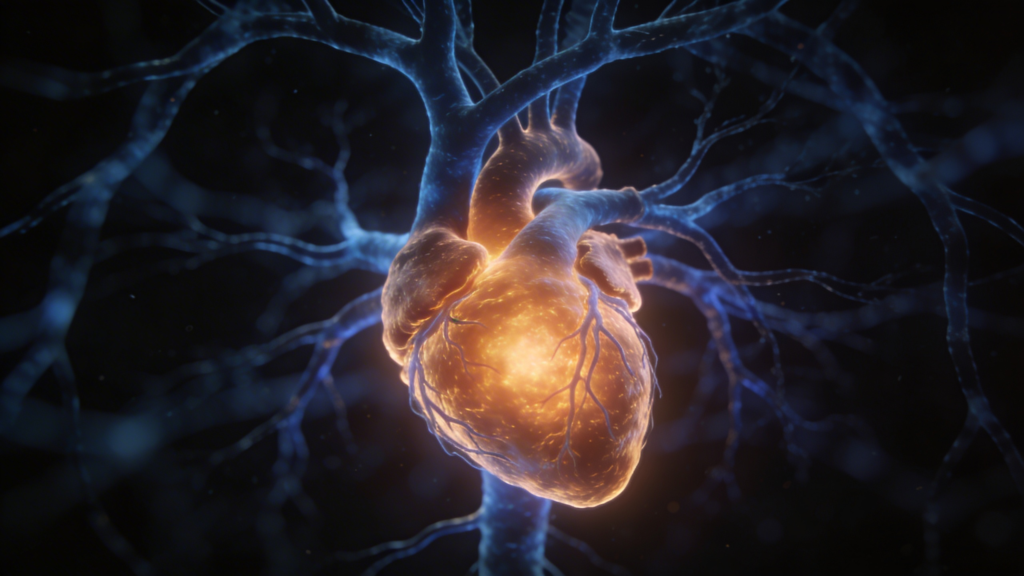
When the diving reflex fires, four things happen in rapid sequence. Each one is a conservation measure. The distinction matters, because the diving reflex is not a relaxation technique. It is an emergency protocol. Your body is not unwinding; it is battening the hatches, deciding in milliseconds which organs receive oxygenated blood and which can wait. What feels like calm — the quieting of the mind, the drop in perceived anxiety — is a byproduct of parasympathetic dominance during a reflex designed to keep an oxygen-deprived animal alive underwater.
Bradycardia comes first. Heart rate drops, in some individuals by as much as 40 per cent, though the typical range is 12 to 40 per cent depending on temperature, fitness, and individual wiring. This is an abrupt, reflexive deceleration imposed by the vagus nerve on the sinoatrial node, the heart’s pacemaker.
Peripheral vasoconstriction follows almost simultaneously. Blood vessels in the extremities clamp down, redirecting blood toward the core, the heart, and the brain.
Splenic contraction adds a third layer. The spleen, which stores a reserve of red blood cells, contracts and releases them into circulation, temporarily boosting oxygen-carrying capacity. In competitive freedivers, this effect is measurable and significant. In a morning ice bath, it is a background contributor.
Metabolic suppression rounds out the response. The body dials down its metabolic rate, reducing oxygen consumption across tissues. Katherine Martien, a physician at Massachusetts General Hospital and Harvard Medical School, has compared the diving response to a form of hibernation: the body decreasing activity to conserve energy and oxygen for the organs that need it most.
Understanding that this is conservation rather than relaxation doesn’t diminish the therapeutic value. If anything, it sharpens it. You are not tricking your nervous system into calming down. You are activating its most powerful autonomic circuit and benefiting from the shift it produces.
Breath-holding is not required
Many people assume the diving reflex requires both cold on the face and apnea to fire. Hayashi and colleagues tested this directly in 1997 and found that face immersion alone, without any breath-holding, significantly increased vagal activity. A 2018 randomised controlled trial reinforced the finding: cold facial stimulation activated parasympathetic pathways independent of respiratory manipulation.
Breath-holding amplifies the response, but it is not required to initiate it. Practically, that matters because it makes the diving reflex accessible to people who find apnea uncomfortable or anxiety-provoking, and it means that even brief contact between cold water and the face, while breathing normally, is enough to engage the circuit.
In fact, cardiologists have known this for decades. The Cold Face Test, a clinical diagnostic that applies cold to the forehead to assess vagal function, has been used in autonomic testing since the 1980s. When doctors need to evaluate parasympathetic function, they test the trigeminal-vagal pathway. When they need to interrupt a dangerously fast heart rhythm, one of the first interventions they try is cold applied to the face.
What changes the strength of the response
Temperature is the dominant variable. A 2025 study comparing facial immersion across a range of water temperatures found that 10°C produced the most profound bradycardia. Warmer water weakened the response progressively, and warm water at 35°C actually produced tachycardia — an acceleration of heart rate, the opposite of the diving reflex. Below 21°C, the response grows proportionally stronger. Middle-aged participants in the same study showed stronger responses than younger ones, running counter to the assumption that autonomic reflexes decline uniformly with age.
Breath-holding amplifies the reflex when layered on top of face immersion, though as the Hayashi data confirms, it is not the primary trigger. Repeated exposure also matters: experienced cold water swimmers and freedivers tend to show a more pronounced and more rapid response than novices, suggesting the reflex, while innate, has a degree of trainability.
That said, individual variation is real. That 12 to 40 per cent heart rate decrease range observed across studies reflects genuine biological diversity, shaped by genetics, baseline fitness, and autonomic health. Some people experience a dramatic cardiac shift on first immersion; others notice a more modest change.
What this means for cold therapy practice
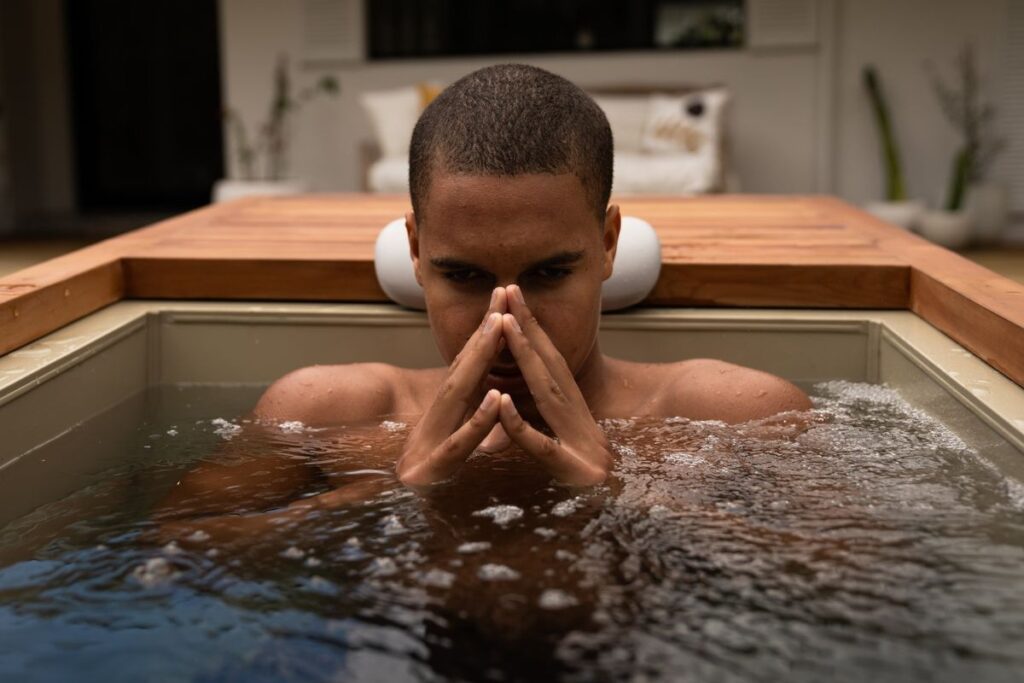
A standard cold plunge with the body submerged and the head above water produces cold shock followed by gradual parasympathetic recovery. Adding even a brief face dunk shifts the balance. Face immersion introduces a powerful parasympathetic signal via the diving reflex that runs counter to the sympathetic drive of the cold shock response, which is partly why many practitioners find that a few seconds of face immersion during a session produces a noticeable settling, a sense of the body finding its footing. In guided cold therapy sessions, face immersion is often introduced as a deliberate step, not left to chance. The reasoning is straightforward: it is the fastest parasympathetic tool available during the session, and guiding someone to use it makes the experience both more manageable and more physiologically complete.
Face-only cold immersion has standalone value, too. For anxiety management, a bowl of water at 10–15°C applied to the forehead and cheeks for 15 to 30 seconds is sufficient to trigger the reflex. Dialectical behaviour therapy programmes already prescribe this as one of the TIPP skills used to manage acute emotional distress. Clinical adoption validates what the physiology predicts: cold on the face is the shortest route to parasympathetic activation.
Al Haddad and Buchheit found in 2010 that cold water face immersion accelerated parasympathetic reactivation after exercise. For athletes and serious recreational exercisers, this suggests that face immersion — whether during a full cold plunge or as a standalone practice — may accelerate the autonomic shift from sympathetic dominance back toward recovery. Bath design plays a role in whether face immersion happens at all: adequate width, clear water, and a comfortable edge to lean into are small details that determine whether the most powerful physiological response available in a cold bath actually gets used.
A note on safety
But the reflex’s power is also the source of its risk. Simultaneous activation of the sympathetic nervous system from body immersion and the parasympathetic nervous system from face immersion can produce what physiologists call autonomic conflict — competing signals that in rare cases may provoke cardiac arrhythmia.
So the practical implication is straightforward: enter cold water gradually rather than submerging face and body simultaneously on a first attempt. If you are new to face immersion, start with your hands cupping cold water to your face while you breathe calmly, well before you progress to submerging your face in a plunge pool. Having someone nearby for your first attempts is good practice, not excessive caution, and anyone with a known cardiac condition should speak with their doctor before triggering a reflex that affects the nervous system so powerfully.
The oldest tool in the autonomic kit
Older than lungs, the diving reflex appears in every air-breathing vertebrate that has been tested, from crocodiles to seals to human infants who have never seen open water. It predates the mammalian cortex by hundreds of millions of years. When cold water touches the ophthalmic branch of your trigeminal nerve and your heart rate drops within six seconds, you are running a circuit that was already ancient before the first mammal drew breath.
That circuit was designed to keep an animal alive when oxygen ran out. But the machinery it activates — vagal tone, parasympathetic dominance, the abrupt quieting of sympathetic noise — is precisely what the modern nervous system struggles to access on demand. The trigeminal nerve fires, the brainstem responds, and the body conserves. In seconds, every time, whether the trigger is a lake at altitude or a cold cloth pressed to the forehead.


