The study that launched a thousand TikToks involved a thermode, not a bag of frozen peas. In a 2018 randomised controlled trial, researchers applied precisely calibrated cold to the lateral neck for sixteen seconds and measured a real parasympathetic shift: heart rate dropped, heart rate variability rose. Cold applied to the forearm did nothing. The effect was specific to the neck, where branches of the vagus nerve sit close to the skin.
So if you’ve pressed a cold compress to your neck at 4am and felt your chest loosen, you weren’t imagining it. But the distance between a sixteen-second laboratory reading and the lasting nervous system change most people are actually hoping for is the part the short-form videos never mention.
What the trend gets right
Cold on the neck triggers a genuine parasympathetic shift: heart rate drops, breathing eases.
This isn’t placebo. Cristin Welle, a neurosurgery researcher at the University of Colorado, has described it as “a legitimate way to access the cranial nerves” through the skin’s surface. The 2018 trial confirmed it with controls: neck stimulation produced autonomic changes that forearm stimulation did not, ruling out the idea that any cold sensation would do the job.
The evidence extends beyond resting conditions, too. A 2022 study applying cold to the face during psychosocial stress found the calming effect held even when participants were actively anxious, with heart rate dropping, HRV shifting, and early indications that the stress hormone axis was being blunted. Cold didn’t just work when you were already calm. It worked when you needed it.
What the trend misses
What the 2018 study measured was a response that lasted seconds. Researchers applied the thermode for sixteen seconds and removed it. Heart rate changes were captured in a controlled lab, participants lying down in a quiet room. No one was measured twenty minutes later, or the next day. It was designed to test whether the mechanism exists, not whether it produces lasting change.
And the tool used in the lab bears little resemblance to a bag of ice. A thermode delivers a precise, consistent temperature to a specific area. An ice pack wrapped in a tea towel delivers uneven cold to a general region, mediated by fabric thickness, skin moisture, and how long you hold it there. Both methods share a principle. They don’t share a protocol.
As Welle noted in a separate interview, “it is not likely that self-manipulation of the vagus can make a long-term change in a patient’s state of depression or ongoing anxiety.” A single cold application can shift your autonomic balance for seconds. Repeated, progressive cold exposure over weeks and months may shift your baseline autonomic tone, the resting state your nervous system defaults to when nothing is happening. One is a rescue technique. The other is training. The trend never makes this distinction, and it’s the most important one in the conversation.
Your nervous system is bigger than one nerve
Part of what makes the trend sticky is its simplicity: one nerve, one ice pack, instant calm. But that framing is more limiting than it needs to be.
Kevin Tracey, president of the Feinstein Institutes for Medical Research, has pointed out that the vagus is not a single wire. It contains roughly 200,000 nerve fibres carrying signals in both directions between the brain and nearly every major organ. When someone asks whether “stimulating the vagus nerve” works, the honest response is: which of those 200,000 fibres? And what kind of stimulation?
None of this diminishes the trend. When you apply cold to your neck, you’re not pressing a button on a single nerve; you’re activating a cascade of autonomic responses, from afferent signals racing to the brainstem to efferent adjustments of heart rate and vascular tone. Calling it “vagus nerve stimulation” is technically incomplete, but the reality is a bigger story, one that explains why cold on the neck feels different from cold on your wrist, and why full-body cold feels different from both.
From compress to immersion
Cold and your nervous system are better understood not as a single technique but as a spectrum, where the depth of the stimulus determines the depth of the response.
A splash of cold water on the face activates the diving reflex, an evolutionarily ancient response that slows heart rate and redirects blood toward the core. It’s fast, accessible, and produces a measurable parasympathetic spike. For a moment of acute panic, it works.
A cold compress on the neck targets the cervical vagus more directly, producing the heart rate and HRV changes the 2018 study captured. It has genuine utility as a calming tool, especially for anxiety that manifests as physical activation: the tight chest, the racing heart. But the stimulus is local, the duration is short, and the adaptation potential is limited.
A cold shower introduces a larger cold dose across more skin, recruiting a broader sympathetic-then-parasympathetic response. Initially, the shock triggers adrenaline and a sharp inhalation; recovery from that shock is where parasympathetic training begins. Over time, repeated cold showers may compress the sympathetic spike and accelerate the recovery. But a shower lacks one thing that changes the physiology.
Full-body cold water immersion adds hydrostatic pressure, and this matters more than most people realise. Research published in the American Journal of Physiology found that water immersion itself, independent of temperature, triggers parasympathetic heart rate control through hydrostatic pressure acting on baroreceptors throughout the body. When you add cold to that hydrostatic stimulus, the effects appear to be cumulative: cold activates autonomic reflexes while the pressure of the water provides a second, independent parasympathetic drive. A compress cannot replicate this. It’s not just more cold. It’s additional mechanisms acting at the same time.
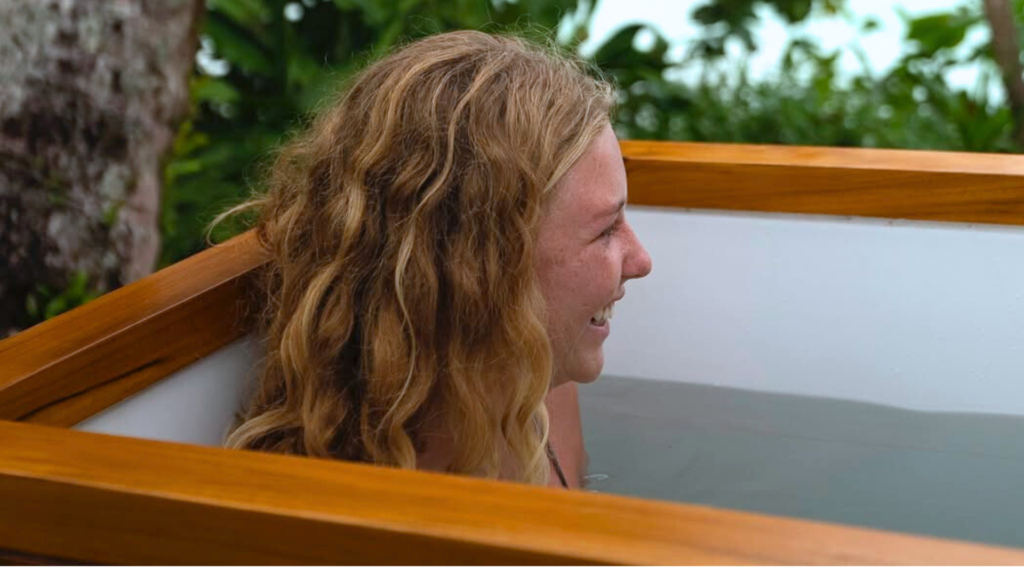
This is where the evidence base becomes significantly stronger. A 2024 meta-analysis across 24 studies found significant increases in parasympathetic markers across cold exposure protocols, with cold water immersion producing the most consistent body of evidence. Regular cold water swimmers, across multiple studies, tend to show higher resting vagal tone than non-swimmers, not just during or immediately after exposure but at baseline, in their everyday autonomic state.
That baseline shift, the one Welle was pointing to when she distinguished acute manipulation from long-term change, is what separates a rescue technique from an adaptation. You can get the acute effect with a compress. Chronic adaptation appears to require sustained, progressive, whole-body exposure.

What this means for you
If what you’re after is a nervous system that runs calmer by default, with higher resting vagal tone and faster recovery from stress, the evidence clearly points further along the spectrum. It points toward regular, whole-body cold exposure that challenges your entire autonomic system, not just the patch of skin above your cervical nerve. Full immersion, repeated over weeks, with enough intensity to provoke the sympathetic spike and enough consistency to train the parasympathetic recovery.
The trend got the starting point right. Cold on the neck activates a real pathway, and feeling calmer afterwards is not imagination. What the fifteen-second videos couldn’t fit is that your nervous system adapts to what you repeatedly ask of it, and a bag of frozen peas, while useful at 4am, is asking for very little.
The question was never whether icing your vagus nerve works. It was what kind of work you’re asking it to do.