
In a climate-controlled room at the New York Academy of Medicine, a scroll of papyrus stretches 4.68 metres. It was written nearly 4000 years ago though the knowledge it records is likely centuries older, the Edwin Smith Papyrus contains 48 cases of battlefield trauma: fractures, dislocations, wounds to the skull and spine. Among the surgical instructions, cold appears again and again as treatment. Not as folklore but as medicine.
The history of cold water therapy does not begin with a trend, a hashtag, or a biohacker standing in an ice bath. It begins here, on a Bronze Age scroll, with an anonymous Egyptian physician reaching for the same intervention that a physiotherapist in Melbourne or a spa guest in Copenhagen will reach for this afternoon. What follows is not a timeline. It is the story of why every civilisation, independently, arrived at the same conclusion about cold water, and why the few attempts to turn that instinct into a tidy clinical protocol have proved less durable than the instinct itself.
The Ancient World: Egypt, Greece, and the Frigidarium
Roger Forshaw, an honorary lecturer at the University of Manchester’s KNH Centre for Biomedical Egyptology, has observed that the Edwin Smith Papyrus follows a logical clinical approach to injuries not so different from what emergency departments practise today. Cases are categorised by severity. Treatments are pragmatic. And cold, applied as compresses to swelling and fresh wounds, is among the earliest recorded therapeutic tools.
By the time Hippocrates was writing in the fifth century BCE, the practice had acquired a theoretical framework. As documented in a 2022 historical review in the European Journal of Applied Physiology, Hippocrates prescribed cold water for both medicinal and analgesic purposes, noting its capacity to reduce swelling and relieve pain. He also recorded a caution that sounds strikingly current: cold could harm as easily as it could help, depending on the patient’s constitution and the severity of application. The dose mattered.
Rome, characteristically, turned the insight into infrastructure. The frigidarium, the cold plunge room in Roman bathhouses, was not an afterthought but architecture, positioned at the end of the bathing sequence after the tepidarium and caldarium. A cold immersion pool completed the sequence: a thermal circuit Romans considered essential to health. Galen wrote about cold’s therapeutic properties in the second century CE, though the specifics of his protocols remain debated. What is clear is the broader Roman commitment: they built the spaces, codified the sequence, and treated cold water immersion as civic infrastructure rather than personal eccentricity.
Egypt used cold as field medicine, Greece gave it a philosophy, and Rome gave it a building. The water hadn’t changed. What people built around it had.
Battlefields and Water Cures: Larrey, Arnott, and Priessnitz
For centuries, cold water therapy continued as folk medicine and monastic practice across Europe and Asia, rarely documented with Hippocratic precision but never abandoned. The next vivid chapter comes from a battlefield.
In 1812, Napoleon’s chief surgeon, Baron Dominique-Jean Larrey, was retreating from Moscow with the remnants of the Grande Armée. Temperatures plunged below minus thirty. Soldiers lost limbs to frostbite. But Larrey, operating in conditions unthinkable in any modern surgical theatre, noticed something extraordinary: frozen limbs felt no pain during amputation. He began packing wounds with snow and ice before surgery, effectively inventing a crude form of cryoanalgesia on the frozen banks of the Berezina River. He also learned the hard way that rapid rewarming destroyed tissue, a discovery Western medicine would take another century to formalise.
Larrey’s contribution was practical and brutal. The next figure in the story was more theatrical. In the 1840s, a Scottish physician named James Arnott began experimenting with salt and ice mixtures to destroy tumours and treat skin conditions, earning the retroactive title of the father of modern cryosurgery. Arnott’s insight was that extreme cold could be used not just to soothe but to ablate, to selectively destroy diseased tissue. It was a leap from Hippocrates’s compresses to something recognisably surgical.
But the most commercially interesting figure of the era had no medical training at all. Vincenz Priessnitz was a Silesian farmer’s son who, around 1829, began treating patients with nothing but cold water: wraps, showers, compresses, immersion. What he had was an instinct for cold water’s therapeutic power, a gift for publicity, and an understanding that people would travel long distances and pay good money to be made uncomfortable in beautiful surroundings. By the 1840s, his water-cure establishment in Gräfenberg was treating an estimated 1,600 patients a year, and the hydropathy movement he helped launch was spreading across Europe and into America.
Priessnitz was less a medical pioneer than the first cold water hospitality entrepreneur. He built a destination. The treatment rooms were purpose-designed, the experience sequenced and ritualised, the stays measured in weeks rather than hours; the work of a man who seemed to grasp that where cold therapy happens changes how it lands.
The Protocol Era: Yamaguchi, Mirkin, and the Rise and Fall of RICE
The twentieth century brought a different ambition: not just to use cold therapeutically but to standardise it, to turn an ancient instinct into a reproducible clinical protocol.
In 1978, a Japanese rheumatologist named Toshima Yamaguchi presented findings at a European congress on his experiments with whole-body cryotherapy. Working with rheumatoid arthritis patients, Yamaguchi had exposed them to extremely cold air, far below what any water bath could achieve, and documented reductions in pain and inflammation. Within a few decades, cryotherapy chambers would appear in sports medicine clinics, biohacking centres, and luxury spas worldwide. The intervention was radically different from three millennia of cold plunges, but the underlying principle was unchanged: expose the body to cold, observe the therapeutic response.

That same year, on the other side of the world, Dr Gabe Mirkin, a sports medicine physician and former associate clinical professor at Georgetown University School of Medicine, published The Sportsmedicine Book. In it, he coined the acronym RICE: Rest, Ice, Compression, Elevation. RICE was simple, memorable, and easy to teach. Within a few years, it had become the default treatment for acute soft tissue injuries across the English-speaking world, printed on posters in locker rooms, taught to parents, embedded in first aid courses. RICE became one of the most widely adopted medical acronyms in modern history.
And then, 36 years later, its inventor took it back.
In 2014, Mirkin wrote on his own website: “Coaches have used my ‘RICE’ guideline for decades, but now it appears that both Ice and complete Rest may delay healing, instead of helping.” The retraction was startling not because it was controversial (the scientific community had been questioning aspects of RICE for years) but because of who was saying it. The doctor who changed his mind about icing was admitting that the evidence no longer supported it.
Inflammation, as Mirkin explained, was the problem — or rather, the solution his protocol had been suppressing. The inflammatory response that ice tamps down is also the body’s primary mechanism for initiating tissue repair. By aggressively icing an injury in its acute phase, you might reduce swelling and pain in the short term while slowing the healing cascade that leads to recovery.
But the full picture is more complicated than “RICE was wrong.” A 2023 review in Frontiers in Sports and Active Living examined the evidence on icing after injury and found it far more ambiguous than either side suggests. Animal studies show that moderate cooling can accelerate aspects of recovery, while extreme or prolonged cooling may impair it. The dose, the timing, and the type of injury all matter. Ice is not useless. The codification of it into a universal four-letter protocol was the problem: the assumption that one rule could govern a response as variable and context-dependent as the human body’s relationship to cold.
This is the pattern that runs through the entire history. The instinct keeps proving durable. The protocols built on top of it keep proving brittle. Hippocrates cautioned about dosage in the fifth century BCE. Mirkin learned the same lesson 2,400 years later.
The Modern Chapter: Wim Hof, the Cold Plunge Boom, and an Older Current
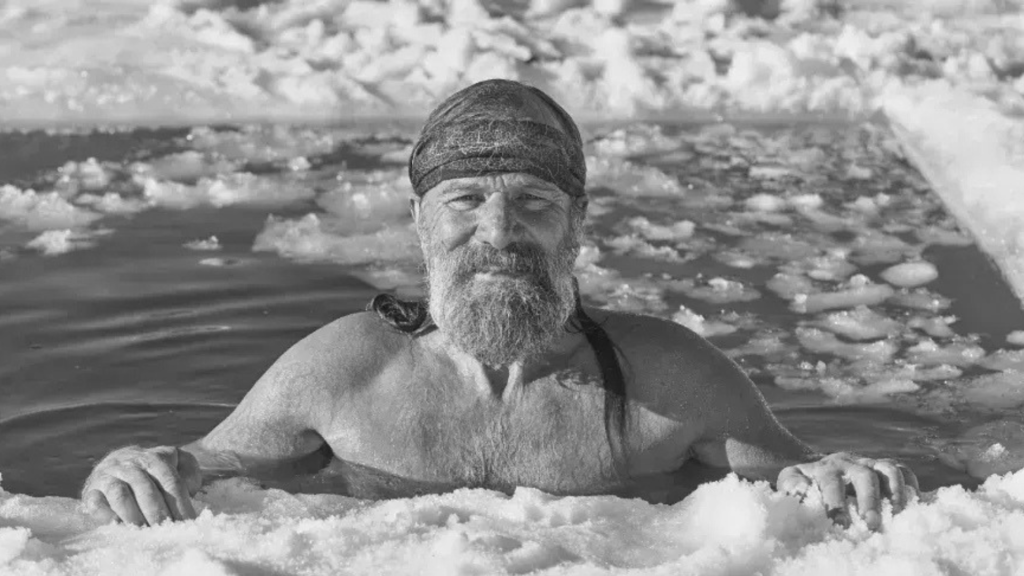
In the early 2000s, a Dutch extreme athlete named Wim Hof began climbing Kilimanjaro in shorts, running half-marathons barefoot above the Arctic Circle, and sitting immersed in ice for nearly two hours at a stretch. His contribution was not scientific discovery but popularisation: he made cold exposure legible to a mass audience, gave it a branded method, and helped trigger a consumer market that barely existed a decade earlier. A cold plunge industry followed: home units, commercial installations, recovery studios, hotel spa programmes, growing rapidly through the 2010s and accelerating after the pandemic, moving cold water immersion from fringe to mainstream faster than almost any other recovery modality.
But the modern chapter is not only Western, and it is not only new. Scandinavia’s sauna-to-lake plunge, Japan’s hot-cold onsen sequence, Russia’s banya with its plunge into snow. None of these cultures needed a peer-reviewed meta-analysis to arrive at the same conclusion.
In Bali, where some of the world’s most carefully crafted cold plunge tubs are now hand-built from Indonesian teak, water has carried spiritual and therapeutic significance for centuries.
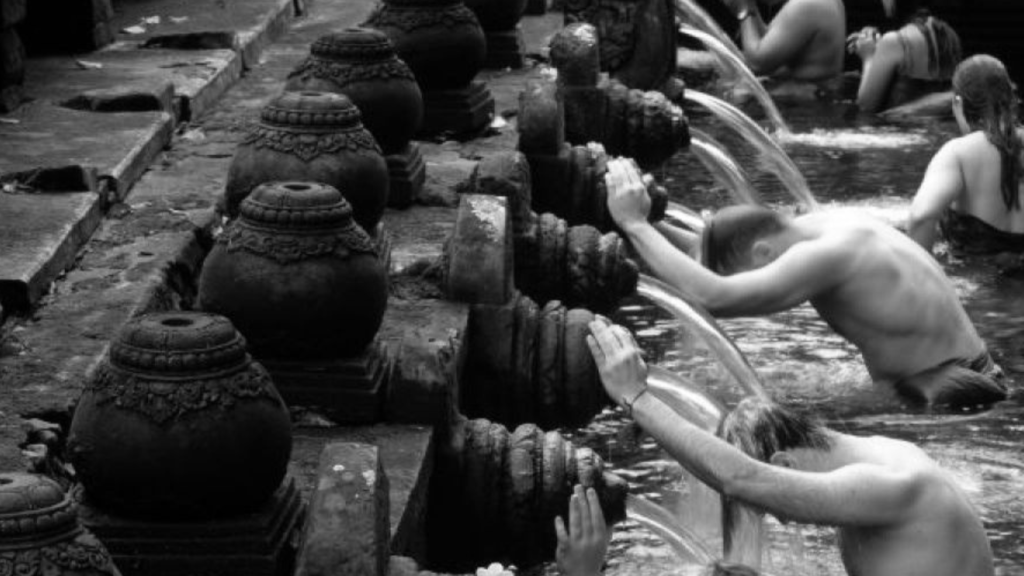
The melukat purification ceremony, a Hindu Balinese tradition practised at sacred water temples, uses flowing water to cleanse negative energy and restore spiritual clarity. Melukat is not cold water therapy in any clinical sense, but something older and broader: an expression of the belief that water itself has the power to heal, to purify, to reset. It belongs to the same deep current that runs from the Edwin Smith Papyrus through the Roman frigidarium and Priessnitz’s spa and Yamaguchi’s cryotherapy chamber — the conviction that immersion changes something fundamental in the body, the spirit, or both.
The Water Stays the Same

Technology changes constantly. Linen compresses become stone pools become purpose-built spa rooms become cryotherapy chambers become digitally controlled chillers housed in hand-shaped teak shells with titanium heat exchangers inside. Every generation believes it has finally modernised the practice. Every generation is partly right and partly missing the point.
Strip away the casing and the essential act is unchanged from what a papyrus scroll described fifty-five centuries ago. You take water. You make it cold. You apply it to the body. And you trust, as every civilisation in recorded history has trusted, independently and repeatedly, that something will shift.
A cold plunge tub in a London wellness studio and a sacred spring at a Balinese water temple are not the same experience. They do not carry the same meaning. But they draw from the same well of human intuition about what cold water does to flesh, to pain, to the quality of attention. That intuition has survived every attempt to dismiss it and every attempt to reduce it to a protocol. It is not a trend. It is one of the longest cultural roots of cold water therapy in human history, and the only thing that keeps changing is the vessel.


