
Most commercial operators default to indoor cold plunge installation because it feels safer – controlled environment, no weather exposure, simpler permits. It’s a reasonable instinct, and in many climates it’s wrong. Placement is a climate decision, an energy decision, and a guest experience decision, and the trade-offs pull in directions most operators do not expect.
The energy economics most operators get backward
A central misunderstanding is that outdoor installation always costs more to operate. Climate zone determines whether outdoor placement helps or hurts the energy bill, and the swing is large enough to change the economics of the entire installation.
In cool and temperate climates (northern Europe, the Pacific Northwest, southern Australia in winter, the northern United States), an outdoor cold plunge benefits from ambient air temperature. A chiller maintaining water at 8°C works hardest against the gap between target temperature and surrounding environment. When the ambient air is 5°C, the chiller barely cycles. When the ambient air is 22°C in a temperature-controlled indoor space, the chiller runs harder — and the building’s HVAC system is simultaneously paying to cool the room while the chiller rejects heat into it. An outdoor installation in a cool climate eliminates this self-defeating loop.
The difference is significant. In a northern European installation operating through autumn and winter, an outdoor chiller may consume 30–40% less energy than an identical system running indoors in a heated building.
In hot and tropical climates (Southeast Asia, the Middle East, northern Australia, the southern United States in summer), the dynamic reverses. Ambient temperatures of 30–35°C mean the chiller is fighting to pull water down by 25°C or more, with direct sun adding thermal load to both the water surface and the equipment housing. An indoor installation in an air-conditioned building, where ambient temperature might sit at 24°C, gives the chiller a meaningful head start.
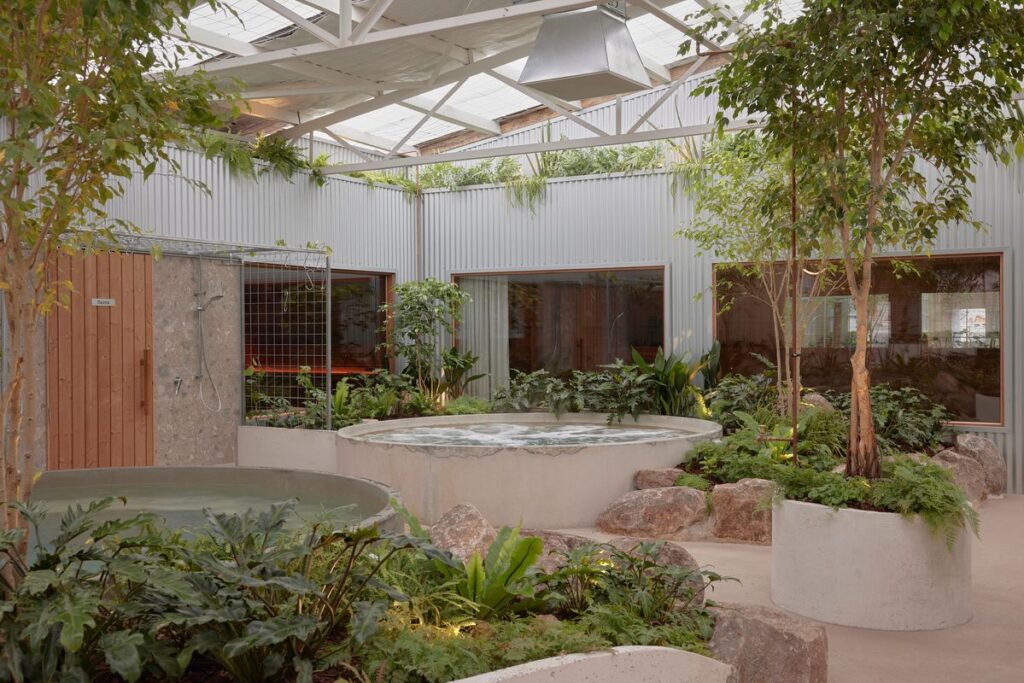
In moderate climates with seasonal swings (the UK, the American Midwest, most of continental Europe), the annual numbers roughly wash — outdoor saves energy in winter and costs more in summer. The operator gains the guest experience advantage of outdoor placement without a meaningful energy penalty.
In practice, the ‘default to indoor’ instinct is energy-correct only in hot climates. In cool climates, it is energy-wrong. In moderate climates, it is roughly neutral.
The humidity problem indoor installations create
A cold plunge at 6–10°C in an indoor space acts as a condensation engine. Every surface near the plunge — walls, floors, ceilings, windows, mirrors — becomes a moisture target. The temperature differential between cold water and ambient air creates persistent condensation that, in a poorly ventilated space, peels paint, develops mould, corrodes metal fixtures, and warps wooden surfaces.
Dedicated ventilation and dehumidification solve the problem, but add capital cost, energy cost, and maintenance complexity. A properly ventilated indoor cold plunge room in a humid climate may require its own HVAC zone, which can cost as much as the outdoor drainage and weatherproofing it was meant to avoid.
In tropical environments, the problem is even more acute. Ambient humidity is already high, the building envelope may not meet northern European sealing standards, and the air conditioning system is already at capacity. Adding a cold-water surface without dedicated dehumidification is a recipe for structural damage within months.
Both options have engineering requirements. The question is which set suits your climate and budget.
The experience payoff of open air
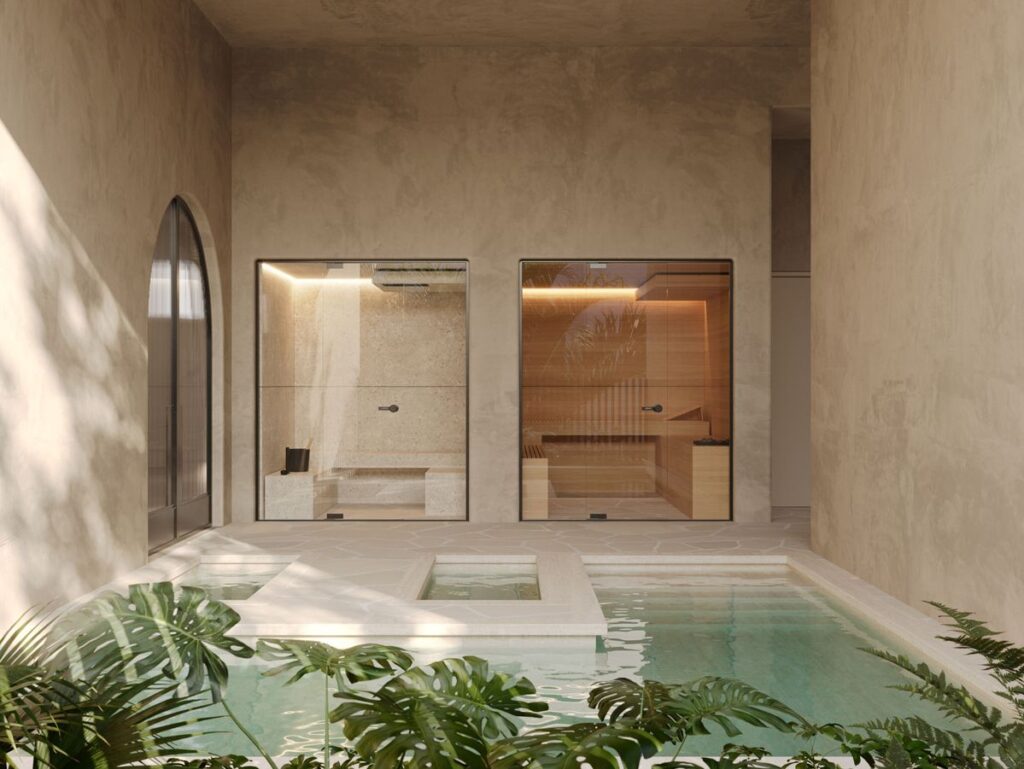
In thermal cycling, the most powerful moment is the transition from extreme heat to cold. When that transition happens indoors, between two rooms with identical lighting and ventilation, the experience is effective but contained. When it happens outdoors — stepping from a hot sauna through a door into cold air and then into a plunge pool under open sky — the sensory contrast multiplies. Cool air on flushed skin. Wind or birdsong replacing the sealed quiet of the sauna. The visual shift from a dim interior to daylight, landscape, stars.
This difference is commercially measurable. Guests photograph outdoor plunge moments at rates indoor installations cannot match. A cold plunge with a mountain backdrop, a rooftop cityscape, or a well-designed courtyard garden generates organic social media content that drives discovery and bookings. For hospitality operators, the outdoor installation often becomes the property’s signature wellness image — the photograph that appears in booking pages, press coverage, and guest reviews.
A climate-design framework
Tropical climates (equatorial, hot-humid year-round)
Recommended configuration: Outdoor with shade structure, or semi-enclosed with natural ventilation.
Energy trade-off: This is the one climate zone where outdoor genuinely costs more to run.
Experience trade-off: Enormous. Tropical resorts are outdoor environments by nature. An indoor cold plunge in Bali or the Maldives feels incongruous — guests came for the outdoors, and moving them inside breaks the spatial narrative.
Operational considerations: Salt air accelerates corrosion on all metal components. Tropical storms deposit debris in open pools. UV exposure degrades certain materials faster. Power supply in remote tropical locations may require voltage stabilisation — unstable grid power can destroy compressors and control boards.
What real installations teach: At Latitude Zero, a surf resort in the Mentawai Islands operating fully uncovered in equatorial conditions, the cold plunge system maintains 6–8°C despite ambient temperatures consistently above 30°C and direct sun exposure throughout the day. The chiller specification had to account for the full thermal load of an equatorial environment with no shade, no breeze barriers, and no infrastructure redundancy. At the Four Seasons Maldives, installation required addressing constant salt air exposure and humidity that would corrode standard fittings within a season. Both succeed because the specification was designed for the climate, not adapted from a temperate standard.
One voltage stabiliser learning deserves emphasis. In markets with unreliable power grids fluctuations harmless to lighting or basic appliances can destroy compressor motors and circuit boards in chiller systems. A voltage stabiliser adds modest cost at installation and prevents catastrophic equipment failure. It’s the kind of specification detail that appears in no brochure and matters enormously in practice.
Temperate climates (four seasons, moderate range)
Recommended configuration: Outdoor is preferred for guest experience, with energy economics roughly neutral across the year.
Energy trade-off: Near-neutral. The chiller saves energy in cooler months and works harder in warmer months. The swing is rarely dramatic enough to drive the placement decision on energy grounds alone.
Experience trade-off: Strong. Seasonal variation itself becomes part of the experience — plunging outdoors in autumn mist or winter frost is qualitatively different from plunging in the same temperature water in a climate-controlled room.
Operational considerations: Winterisation matters where temperatures drop below freezing for extended periods. Exposed plumbing must be protected or drained. Plunge water itself is unlikely to freeze if the chiller maintains it above 4°C, but peripheral systems (drainage, fill lines, overflow pipes) need freeze protection. Wind management is relevant for outdoor saunas — an unshielded sauna in a windy location loses heat rapidly through the door opening.
Cool and cold climates (Nordic, northern North America, highland)
Recommended configuration: Outdoor is energy-optimal, but semi-enclosed configurations may be necessary for guest comfort during extreme cold.
Energy trade-off: Strongly favourable for outdoor. The ambient environment does much of the chiller’s work, and in deep winter the chiller may barely run.
Experience trade-off: The outdoor hot-to-cold transition is at its most dramatic here — stepping from a 90°C sauna into 6°C water under a Nordic sky is arguably the pinnacle of the thermal cycling experience. But extreme cold (below -15°C) creates practical challenges: icy walking surfaces, the shock of extreme ambient temperature compounding the water temperature, and guest reluctance to be outdoors in minimal clothing when the air is punishing. Nordic facilities manage this with heated walkways, wind barriers, and careful path design that makes the transition feel exhilarating rather than hostile.
What you’re optimising for
Three priorities compete, and the right answer depends on which the operator weights most heavily.
Minimal maintenance and controlled conditions: Indoor wins. No weather variables, no UV degradation, no seasonal adjustments. The humidity and condensation challenges are real but manageable with proper ventilation design.
Guest experience and marketing impact: Outdoor wins in nearly every climate zone. The sensory power of outdoor thermal cycling, the organic content it generates, and the visual signature it creates for the property outweigh the engineering complexity for most hospitality operators.
Energy efficiency: The answer depends on geography. Cool climate: outdoor. Hot climate: indoor. Temperate climate: roughly equivalent, so let the experience argument tip the balance.
The evidence is clear: the assumption that indoor is always simpler, always cheaper, and always the sensible default is wrong often enough to be dangerous. The climate, the guest, and the energy bill all have a say.

