
Two thousand years before any operator sketched a contrast therapy room design on a napkin, Roman architects had already solved the problem. The thermae at Caracalla moved bathers through a sequenced circuit — caldarium to tepidarium to frigidarium — where the architecture choreographed the thermal journey. Hot rooms opened into transitional spaces that opened into cold plunges, each threshold calibrated so the body experienced a deliberate shift rather than a shock. The logic was spatial, not mechanical: proximity determined intensity, and the design principles that informed those layouts remain structurally sound today.
Contrast therapy suites are now a defining spa design trend for 2026, with membership clubs and hotel wellness programmes building entire offerings around the hot-to-cold circuit. As Don Genders, CEO of Design for Leisure and chair of the GWI Hydrothermal Initiative, has observed, US hospitality properties are replacing conventional treatment rooms with self-service bathing circuits modelled on European hydrotherapy traditions. The demand is clear. Published guidance on how to actually design these spaces is not.
Beverley Bayes, Creative Director at Sparcstudio, framed the challenge precisely when she told Hotel Designs: “Good design and the creation of a unique offer that reflects the overall aesthetic of the facility is key to the feeling of wellbeing within a recovery suite.”
What the guest sees and feels matters as much as what the system does, possibly more, because perception of quality determines willingness to return and to pay.
At icebaths.com, we have designed and installed contrast therapy environments across more than 100 commercial projects, from five-star tropical resorts to high-volume urban gyms. What follows distils that operational knowledge into a decision-by-decision framework we wish had existed when we started.
The temperature decision that shapes everything else
Temperature is the first question every operator asks, and the one most often answered too simply. Cold water between 3°C and 10°C, heat between 80°C and 100°C for a traditional sauna, technically correct and operationally useless. It does not account for who is getting in.
Our most commercially consequential finding: temperature settings should be calibrated to your clientele, not to a protocol chart. At the W Hotel Bali, we set the cold plunge at 6°C. The guests skew younger, fitness-aware, and actively seeking intensity. They want to feel something sharp, and they talk about it afterwards. At NXT Fit, a gym-based recovery facility in Jakarta, we installed a dual-temperature system: one plunge at 4°C for experienced users, another at 10°C for beginners. That split changed the facility’s retention profile.
App data across our commercial installations reveals a consistent pattern: roughly 30% of users gravitate toward temperatures below 6°C, while 70% prefer the range above. More telling is what happens to beginners. Facilities that offer only sub-6°C plunges tend to see higher dropout rates among first-time users. Facilities that provide a warmer entry point, 10°C or above, typically retain beginners at better rates through their first month. For any operator building a membership model, this is not a comfort preference. It is a revenue decision.
Design the temperature experience for the person most likely to return, not the person most likely to post about it.
On the heat side, the choice between a traditional Finnish sauna (80°C–100°C) and an infrared cabin (45°C–65°C) is less about which is superior and more about your constraints. Infrared requires less ventilation, less ceiling height, and lower energy consumption, making it useful in retrofits. But in purpose-built contrast therapy rooms where the full thermal arc is the point, the traditional sauna delivers the more dramatic contrast and remains the stronger design choice.
Layout: why proximity is the make-or-break decision
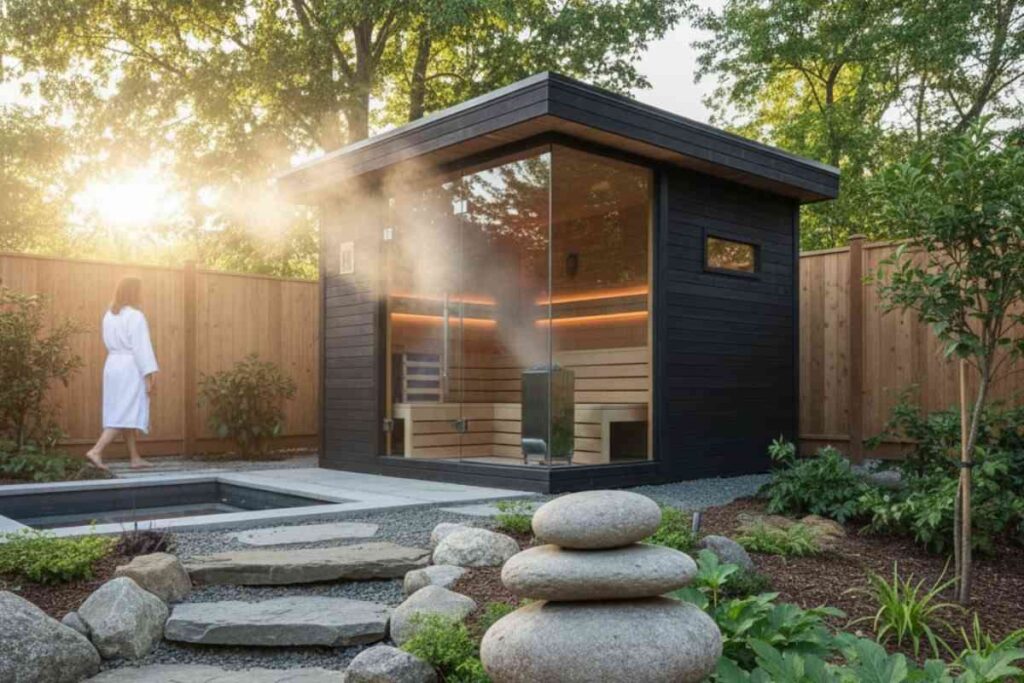
If temperature shapes who uses the space, layout shapes how they experience it. Every installation reinforces the same spatial principle: three to five steps between heat and cold.
When the distance between sauna and plunge exceeds five paces, the contrast experience fractures. Guests cool down in transit. Psychological momentum dissipates, and the ritual can become two separate activities rather than one continuous arc. When the distance is right, the transition feels inevitable — the body moves from one state to the next without deliberation.
At the W Hotel Bali, we integrated the plunge directly into the existing spa wet area, positioning it within immediate reach of the sauna. What began as a spatial constraint became an asset of the experience. At NXT Fit, the contrast therapy zone was purpose-built, allowing us to design the full circuit from scratch: sauna, transition bench, dual cold plunges, rest area. The spatial sequence reinforces the intended flow — heat first, brief pause, cold immersion, recovery — every time a guest moves through it.
Between heat and cold, the transition zone deserves more attention than it typically receives. A bench, a step-down area, a short corridor with a change in lighting: these intermediate spaces give the guest a moment of anticipation and serve as a natural point for the pre-immersion rinse that hygiene demands. At The Meru, a boutique wellness space with tight dimensions, this was reduced to a single step platform with an integrated rinse shower. Compact, but present. Eliminating it entirely would have diminished the experience. Surface materials and drainage through the full circuit should be specified for continuous wet traffic, not occasional splashes: non-slip stone, textured tile, or marine-grade composite throughout, with drainage that handles water migrating constantly from plunges to floors.
The concealment principle: where equipment ends and ritual begins
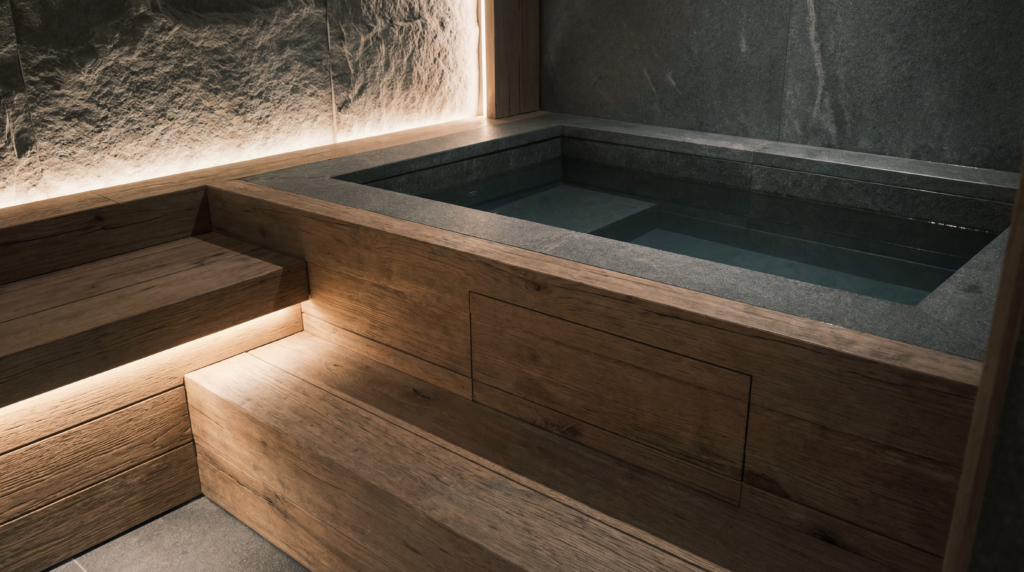
We call it the concealment principle: the engineering disappears, the ritual remains.
In practice, this means the chiller unit sits beneath a step platform or in an adjacent plant room rather than humming visibly beside the plunge. It means choosing white fibreglass for the vessel because water looks cleaner and more inviting against a light surface. It means routing chiller lines through walls rather than across floors. It means acoustic zoning, sound-absorbing panels and strategic placement, so mechanical noise from chillers and filtration never reaches the bathing space.
At the W Hotel, the entire refrigeration and filtration system was concealed below a raised platform. Guests step up to the plunge and see only water and teak. The engineering that maintains that water at 6°C in 35°C ambient heat is invisible to them. At Rekoop Flex, a recovery studio designed for controlled session bookings, the plant equipment was housed in a dedicated service corridor behind the treatment rooms. Guests see calm, warm-lit, material-rich surfaces. The corridor behind the wall is pure mechanical infrastructure.
Lighting is the most underestimated sensory variable. Indirect, warm-toned lighting in the heat zone transitioning to cooler, slightly brighter light near the plunge can subtly reinforce the thermal contrast. Harsh overhead fluorescents, still common in gym-based setups, can flatten the entire experience. In many cases, what separates a clinical contrast therapy room from a destination is entirely a lighting decision.
Natural materials and a restrained palette reinforce coherence. Teak, stone, linen: when every surface, sound, and sightline supports the same experience, the guest trusts the space enough to return.
Guest flow and throughput: the business model shapes the room
A contrast therapy room designed for open-access hotel guests operates on different principles than one designed for scheduled studio sessions. Your throughput model should drive spatial decisions from the earliest stage of planning.
At the W Hotel Bali, the plunge operates as part of an open-access spa wet area, handling fifty or more plunge sessions on busy days. No booking system for the plunge itself; guests move through at their own pace. That demands a plunge large enough for back-to-back use without uncomfortable overlap, water treatment robust enough for continuous bather load, and a layout that lets multiple guests circulate through the circuit simultaneously.
Rekoop Flex operates on the opposite principle. Sessions run sixty minutes, booked in advance, typically serving one to four guests. The space can be smaller. Every element can be more curated: guided lighting sequences, timed intervals, controlled music. That model justifies a higher per-session price, which in turn justifies a more considered design investment per square metre.
NXT Fit introduced a third variable: gender-segregated contrast therapy zones with separate plunges and saunas, doubling the spatial footprint but aligning with cultural expectations in its Malaysian market. That single decision reshaped every spatial calculation in the project.
The question to answer before you draw a floor plan is not “how large should the room be?” It is “how many people will use this space per hour, in what group sizes, with what level of guidance, and how does that align with my revenue model?”
Hygiene at commercial scale
A home plunge used by two people and drained periodically can manage with basic filtration and occasional treatment. A commercial plunge used continuously by dozens of different bodies every day cannot.
Commercial cold plunge sanitation requires a multi-layer system: mechanical filtration to remove particulates, UV or ozone disinfection to neutralise pathogens, and a controlled residual disinfectant, typically low-level bromine or chlorine, to maintain water quality between cycles. No single layer is sufficient on its own: filtration cannot kill bacteria, UV treats only water passing through the unit at that moment, and residual disinfectant degrades faster in cold water than most operators expect.
Pre-immersion rinsing is the single most effective hygiene intervention in the design. It reduces organic load entering the plunge — sweat, skin oils, cosmetic products — before the filtration system has to deal with it. A layout that makes rinsing natural and unavoidable, rather than optional and inconvenient, pays for itself in reduced chemical consumption and longer water life.
Water management is an integrated system decision, not an afterthought. Specify it alongside the plunge, not after installation. Size it for your peak bather load, not your average.
Climate as a hidden design variable
Most published guidance assumes a temperate climate. For operators in tropical, subtropical, or high-humidity environments, a substantial and growing portion of the global wellness market, most published guidance quietly falls short.
Maintaining a cold plunge at 6°C when ambient air is 35°C and humidity runs above 80% is a different engineering challenge entirely from doing so in a London basement at 18°C. Chillers work harder, energy consumption rises, and condensation becomes a design problem: cold surfaces in humid environments produce water on every exposed pipe and fitting.
At Latitude Zero, an off-grid surf resort, we designed the cold plunge system around extreme heat and limited power infrastructure. Chiller capacity had to be oversized well beyond what plunge volume alone would suggest, and the entire system was engineered to manage condensation in an open-air tropical setting. At the Four Seasons Maldives, the challenge was similar but the infrastructure budget different, allowing for more sophisticated climate control. In both cases, the lesson was identical: climate is not a footnote in the specification but a primary design variable that changes chiller sizing, insulation requirements, energy budgets, and material selection.
If your property sits anywhere that average temperatures exceed 28°C, add a minimum of 30% to the chiller capacity you would specify for a temperate installation. Plan for condensation as a maintenance reality, not an edge case.
The design challenge that matters
What separates a contrast therapy room that guests return to from one they try once is never the equipment brand, the chiller wattage, or the sauna heater specification. It is the quality of the decisions made around those objects: temperature calibrated to the people who will actually use the space, a layout where three steps carry the body from heat to cold without hesitation, materials and lighting that make the guest feel they have arrived somewhere considered, a throughput model that matches the business it serves, hygiene systems built for continuous commercial use.
The best contrast therapy rooms are the ones where the guest never thinks about the engineering. The experience feels as ancient and inevitable as stepping from a warm room into cold water. The system behind it is precisely, quietly modern.


