A “cold” shower in Bali runs at about 27°C. In London, the same tap delivers water closer to 10°C. In Singapore, Dubai, Jakarta, anywhere within fifteen degrees of the equator – the infrastructure around you simply cannot produce the sensation of being cold. There is no brisk morning air, no naturally cool lake, no winter to remind your skin what a chill feels like. If you want a cold plunge in a hot climate, you have to manufacture cold from scratch.
Every competitor article on the subject treats this as a problem: shade your tub, insulate the lid, add more ice. But our data across more than 500 installations in Bali, Jakarta, Singapore, and the Gulf tells a different story. Tropical users don’t go warmer to compensate for the heat. They go colder — markedly colder than standard Western protocols suggest.
What 500 tropical installations actually show
Across our Bali installations, the average user-selected temperature is 7°C. Not 15°C, not the 10–12°C that most beginner-to-intermediate guidance recommends, but a full seven degrees. Roughly 30 per cent of Bali users set their units to the coldest available range, between 3°C and 4°C. These aren’t professional athletes running structured recovery protocols. Many are expats, surfers, yoga practitioners, and local gym-goers who, when asked why they plunge so cold, give some version of the same answer: it’s just nice to get cold.
That response tells you more about tropical cold therapy than any protocol guide can. In a climate where “cold” doesn’t naturally exist — where even the rainy season sits above 25°C – the craving for genuine cold is not an extreme wellness behaviour. Across tropical populations, “cool” consistently ranks as the preferred thermal state – a pattern documented in Indonesian thermal comfort research and one that makes the craving for cold water immersion less surprising than it first appears. Cold isn’t alien to tropical cultures. Artificial cold, the kind a well-engineered ice bath delivers, may be filling a gap that the climate itself creates.
Our Jakarta data offers a useful comparison: the average selected temperature there runs closer to 9°C, still well below Western guidelines but noticeably less aggressive than Bali. The difference reflects demographics rather than climate. Ambient conditions are nearly identical – and Jakarta’s user base skews toward gym and commercial fitness settings while Bali’s leans toward lifestyle and surf recovery. The sample is smaller and the pattern suggestive rather than definitive, but the behavioural variation is real.
What isn’t speculative is the headline finding: tropical users, left to their own preferences, choose temperatures that would be considered advanced or aggressive by most published Western cold therapy guidance. This is the clearest signal in the data, and it holds across every market we operate in. No peer-reviewed study has specifically examined cold water immersion behaviour in year-round tropical populations. This is, as far as we can tell, the first dataset of its kind.
The thermal gradient: why hotter starting conditions change everything
The explanation for why tropical cold therapy feels so intense sits in a concept called the thermal gradient. As physiologists at the US Army Research Institute of Environmental Medicine have explained, “the larger the difference between body temperature and the temperature of the water known as the thermal gradient, the greater the rate of heat loss.” If you step into 7°C water from a 33°C tropical afternoon, the temperature gap your body must reconcile is substantially larger than if you step into the same water from a 15°C autumn morning in Copenhagen.
That steeper gradient produces a faster, more pronounced cold shock response. Your skin receptors fire more aggressively. Your sympathetic nervous system activates with greater urgency. And the neurochemical cascade that follows appears to scale accordingly: a controlled 2000 study by Srámek and colleagues found that immersion at 14°C increased plasma dopamine concentrations by 250 per cent and noradrenaline by 530 per cent. It hits immediately, unmistakable and satisfying in a way that feels different from plunging in cooler climates. (As Daanen’s 2016 review of human cold adaptation notes, Homo sapiens evolved in tropical Africa, the idea that cold therapy “belongs” to Nordic cultures is a historical accident of who commercialised it, not a reflection of who might benefit most.)
The post-plunge experience is different in the tropics too. When you exit an ice bath in Bali, you step into 30°C air and your body reheats almost immediately. Research by Dr Susanna Søeberg, the metabolism researcher whose cold-exposure work popularised the “end on cold” principle, suggests that allowing the body to rewarm naturally drives some of the metabolic benefits of cold exposure, and in the tropics, that rewarming is so fast it may blunt the shivering-driven thermogenesis pathway. But it also makes the practice dramatically more accessible. Between cold water and warm air, that contrast creates a sensation of alertness and physical wellbeing that lands within seconds. For many tropical users, that immediate payoff is the entire point.
Engineering reality: when the climate fights the chiller
If the tropics are physiologically ideal for cold therapy, they are mechanically punishing. The engineering is significantly harder here — not speculation but the central operational reality of every installation we manage.
A refrigeration circuit’s efficiency depends on its ability to reject heat into the surrounding air. When ambient air sits at 35°C, standard for midday in Bali, typical year-round in the Gulf, the condenser has less thermal headroom. According to industrial data from JULABO, a refrigeration system can lose up to 75 per cent of its rated cooling power when operated at 38°C ambient. That aligns precisely with our field experience: a chiller rated for 1kW of cooling capacity in a European test environment may deliver 250W of usable cooling in a Balinese garden at noon.
From here, the implications cascade quickly. Undersized chillers, particularly cheaper units designed and rated in temperate conditions — cannot reach or maintain their stated temperatures in persistent tropical heat. They run constantly, overheat, and fail. Compressor lifespan drops. Energy consumption spikes. And if the unit is connected to unreliable local power, which it frequently is across Southeast Asia, the failure rate accelerates further.
Voltage stabilisation became one of our earliest and most consequential operational lessons. In Canggu, in Seminyak, across much of Bali’s commercial and residential grid, voltage fluctuations are a fact of life. A nominal 220V supply might sag to 180V during peak load or spike above 250V during quiet periods. Refrigeration compressors are sensitive to this instability; a sustained undervoltage event can burn out a compressor motor in a single evening. We lost multiple units before identifying the pattern. Now every tropical installation ships with an appropriately rated voltage stabiliser as standard. A residential-grade stabiliser costs under $100. Field failures dropped sharply.
Sizing and placement rules follow from all this, and they are specific. Chiller capacity needs to be rated for the actual ambient conditions, not the factory-test conditions; we typically specify at least double the nameplate capacity that would be appropriate for the same tub volume in a European setting, because oversizing and running at partial load produces better temperature stability, lower energy costs, and longer equipment life than running a correctly sized unit at full capacity around the clock. Condenser placement matters more here than anywhere else: direct sunlight on the condenser can push effective ambient temperature above 50°C, collapsing cooling capacity to nearly nothing, so shaded, well-ventilated placement with at least 300mm of clear airflow space around the coils is non-negotiable. Water hygiene requires more diligence too, since ambient water temperatures above 25°C accelerate bacterial and algal growth between plunge sessions, making a robust filtration and sanitation system – UV, ozone, or both – baseline rather than optional. And insulation carries more weight when the delta between water temperature and ambient air is 25–30°C rather than 10–15°C; tub construction, lid seal, and pipe insulation all affect whether the chiller spends its energy maintaining water temperature or fighting heat ingress from the environment.
Hospitality in the tropics: the W Hotel and what operators learn
The W Hotel in Bali offered one of our clearest case studies of how cold therapy behaves in a high-traffic tropical hospitality environment. Before our installation, the property already offered a cold bath held at approximately 16°C. When we installed a dedicated unit capable of reaching 4°C, the contrast was immediate. Guests who had been lukewarm on the existing bath gravitated toward the colder option. At peak periods, the 4°C unit logged more than 50 plunges per day. The hotel now runs a dual-temperature setup: the original 16°C bath serves as an approachable entry point, while the colder unit serves experienced guests and generates the social-media moments that drive organic visibility for the spa.
For hospitality operators in tropical markets, the lesson is specific: guest demographics drive temperature calibration more than climate does. A resort in Canggu drawing a younger, active, surf-adjacent crowd will see higher demand for aggressive temperatures than a five-star spa in the Maldives serving a more conservative luxury demographic. Both are tropical. The user behaviour differs substantially.
What doesn’t differ is the social dimension. Tropical cold therapy skews communal and visible in ways that a Nordic spa or a private garage does not. Poolside, garden-adjacent, positioned in a public wellness area — the ice bath is always visible. People watch each other plunge. They encourage. They film. The practice spreads through observation and social proof in exactly the way a hospitality operator would design for if they were starting from scratch. In our tropical installations, the ice bath is never a back-room recovery tool. It is the most visible piece of equipment in the space.
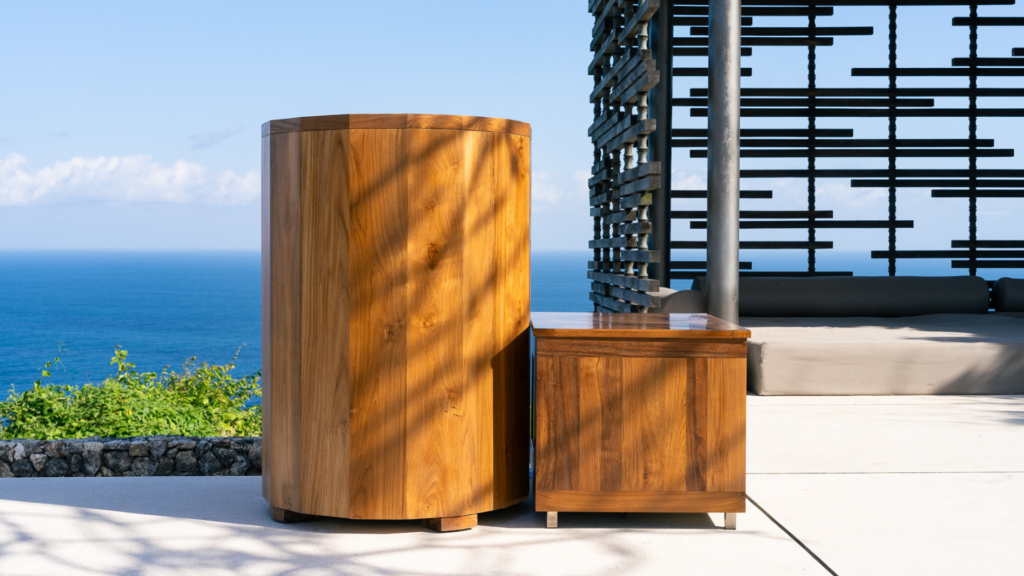
Material choices follow from this visibility. Marine-grade hardware, UV-resistant finishes, and tropical hardwoods like teak aren’t aesthetic upgrades in equatorial environments, they’re functional requirements. Salt air, equatorial UV exposure, and constant high humidity destroy equipment that would last a decade in a temperate indoor setting. We build for outdoor year-round placement as the default, because in the tropics, that is the default. Equipment becomes part of the space’s architecture rather than something bolted into a corner, and that changes how guests perceive the practice, how often they return to it, and how they talk about it afterward.
Where cold has always wanted to be
Cold therapy grew up in cold climates because that is where cold was available. Scandinavian ice swimming, Japanese cold-water misogi, Russian ice-hole bathing, the traditions emerged where the resource existed naturally. Modern commercial cold therapy followed the same geography, developing equipment specifications, temperature guidelines, and cultural norms calibrated to Northern European and North American conditions.
But availability is not affinity. Our data, imperfect, self-selected, commercially derived, and still the only dataset of its kind, points in one clear direction: the people who choose the coldest temperatures and return most consistently are the ones for whom cold is rarest. Where the thermal gradient is steepest, the neurochemical reward sharpest, and the simple sensation of being genuinely cold is something you cannot find anywhere else in your daily life.
A cold shower in London is already cold. A cold plunge is an intensification of something the climate already offers. A cold shower in Bali is barely cool. The ice bath isn’t an intensification, it’s the only source. And that scarcity, it turns out, changes everything about how people use it and what it means to them.